

Most websites lose over 90% of their visitors within the first 15 seconds because readers cannot find what they need. Search engines penalise poorly organised pages with lower rankings and reduced visibility.
Content structure determines whether your article ranks on page one or disappears into obscurity. Google now prioritises user experience signals like dwell time, scroll depth, and engagement metrics when evaluating page quality.
This guide reveals how to build content frameworks that satisfy both human readers and search engine algorithms. You will learn proven structural patterns, formatting techniques, and optimisation methods that top ranking pages use to dominate search results.
What is Content Structure?
Content structure refers to the logical organisation and hierarchy of information within a webpage or article. This framework includes headings, subheadings, paragraphs, lists, and visual elements arranged to guide readers through your message a key aspect of What is SEO and how it enhances user engagement.
Proper structure creates a clear pathway from introduction to conclusion. Each section builds upon previous information while maintaining focus on the central topic. Well structured content allows readers to scan, comprehend, and extract value quickly, contributing to better performance in What is SEO strategies.
Search engines analyse structural elements to understand topic relevance and content quality. Google’s algorithms examine heading tags, paragraph length, internal links, and semantic relationships between sections. Pages with clear hierarchical organisation typically outrank disorganised competitors by 40–60%, proving the importance of structure in what is SEO.
Why Content Structure Matters for SEO
Search engines cannot perceive content the way humans do. They rely on structural signals like HTML tags, schema markup, and semantic patterns to interpret meaning and context, providing significant SEO benefits.
Google’s crawlers scan heading hierarchies to build topic maps of your content. Pages with logical H1 H2 H3 progression receive higher topical authority scores. This structural clarity helps search engines match your content to relevant queries more accurately, resulting in strong SEO benefits.
User engagement metrics directly influence rankings. Readers spend 70% more time on well structured pages compared to text heavy walls of information. Lower bounce rates and higher dwell time signal content quality to Google’s RankBrain algorithm. Structured content also generates more backlinks because other websites prefer citing organised, authoritative resources, further boosting SEO benefits.
How Content Structure Works in Modern SEO
Content structure operates through multiple interconnected systems. Heading tags create visual and semantic hierarchy that guides both readers and crawlers through your information architecture.
HTML heading elements (H1 through H6) establish parent child relationships between topics. Your H1 introduces the primary subject while H2 sections break it into major subtopics. H3 tags support H2 sections with specific details or examples.
Search algorithms analyse these relationships to determine topical depth and expertise. Pages covering subjects comprehensively with proper hierarchical structure rank higher for informational queries. Google’s passage indexing now evaluates individual sections independently, making structural clarity more critical than ever.
Internal linking within your structure creates topical clusters. Linking related H2 sections across multiple pages builds semantic networks that boost domain authority. This interconnected framework helps search engines understand your site’s expertise areas.
Best Practices for Content Structure
Start every article with a single H1 tag containing your primary keyword. This heading should communicate the main benefit or answer readers seek when searching your topic.
Break your content into 7 10 major H2 sections covering distinct subtopics. Each H2 should address a specific question or aspect of your main topic. Use descriptive, keyword rich headings that preview the section’s value.
Keep paragraphs between 30 50 words maximum. Short paragraphs improve mobile readability and reduce cognitive load. Each paragraph should express one complete idea before moving to the next concept.
Insert blank lines between all paragraphs and headings. White space improves scanning behavior and reduces reader fatigue. Dense text blocks cause 58% of visitors to abandon pages immediately.
Use transitional phrases to connect sections smoothly. Phrases like “this approach works because” or “now that you understand X” create logical flow. Avoid abrupt topic changes that confuse readers and search engines.
Add visual breaks with images, charts, or examples every 300 400 words. Visual elements increase engagement by 94% and help explain complex concepts. Always include keyword rich alt text for image accessibility and SEO value.
Common Content Structure Mistakes
Many writers create multiple H1 tags per page, confusing search engines about primary topic focus. Use exactly one H1 tag per page to establish clear topical authority.
Skipping heading levels disrupts hierarchical logic. Never jump from H2 directly to H4 without an intervening H3. This breaks semantic relationships that search algorithms rely on for content interpretation.
Generic headings like “Overview” or “More Information” waste valuable SEO opportunities. Descriptive headings containing target keywords help pages rank for long tail queries. Replace vague labels with specific, benefit driven headlines.
Creating excessively long sections without subheadings overwhelms readers. Break H2 sections longer than 400 words into H3 subsections. This improves scanability and allows search engines to index individual concepts more precisely.
Inconsistent formatting confuses both humans and algorithms. Maintain uniform styling for similar elements throughout your content. Use the same list format, heading capitalisation, and paragraph spacing across all sections.

Tools for Optimising Content Structure
Hemingway Editor analyses readability and highlights complex sentences that need simplification. This SEO Tools helps maintain grade 8 9 reading levels that engage broader audiences while preserving expertise.
Surfer SEO provides structural analysis comparing your content against top ranking competitors. The platform suggests optimal heading counts, paragraph lengths, and keyword placement patterns based on current SERP leaders, making it a powerful SEO tool.
Screaming Frog SEO Spider crawls your site to identify structural issues like missing H1 tags, duplicate content, or broken hierarchies. Regular audits with this SEO tool prevent structural degradation as your content library grows.
Clearscope offers real time content grading based on topical coverage and semantic relationships. The SEO tool recommends additional subtopics and related terms to strengthen your structural framework.
Google Search Console’s Page Experience report reveals how users interact with your structured content. This SEO tool helps monitor average engagement time and scroll depth metrics to identify sections that need structural improvements.
Schema markup generators help add structured data vocabularies that enhance search appearance. These SEO tools implement Article, FAQ, and HowTo schemas to increase visibility in rich results and featured snippets.
Advanced Content Structure Strategies
Create pillar cluster topic architectures where comprehensive pillar pages link to detailed cluster content. This hub and spoke model builds topical authority by demonstrating subject expertise across multiple related articles.
Optimise section headers for voice search queries. Structure H2 tags as natural questions that mirror conversational search patterns. This increases chances of appearing in voice assistant responses and featured snippets.
Implement progressive disclosure techniques for complex topics. Start sections with simple explanations before advancing to technical details. This accommodates readers at different knowledge levels while maintaining engagement.
Use inverted pyramid structure placing critical information first. Front load each section with the most valuable insights before supporting details. This respects reader time and reduces bounce rates from impatient visitors.
Build comparison tables and structured lists for data heavy content. These formats earn featured snippet placements 3x more often than traditional paragraph structures. They also improve scanability and decision making for commercial queries.
Add jump links to H2 sections for long form content exceeding 2,000 words. Table of contents navigation improves user experience and increases dwell time by helping readers find relevant sections instantly.
Measuring Content Structure Performance
Track average time on page across different content types. Well structured articles should maintain 2+ minute average engagement for informational content and 1+ minutes for commercial pages, showing the impact of effective
Monitor scroll depth percentages to identify where readers disengage. Sections with sharp drop offs need structural improvements like better subheadings, shorter paragraphs, or visual breaks to maintain attention.
Analyse pages per session metrics for internal link performance. Properly structured content with contextual internal links should generate 1.8–2.5 pages per session as readers explore related topics.
Review featured snippet ownership for your target keywords. Content structured with clear question answer patterns earns 40% more featured positions than traditionally formatted articles.
Examine bounce rate differences between mobile and desktop users. Mobile visitors abandon poorly structured content 68% faster than desktop readers. Ensure your structure adapts seamlessly across all device types.
Use heat mapping tools like Hotjar to visualise how users navigate your content structure. Identify which sections attract the most attention and which formatting patterns encourage deeper engagement.
Content Structure for Different Content Types
How to guides require sequential step based structures. Number your main H2 sections as Step 1, Step 2, etc. Include what users need and expected outcomes for each step to build confidence.
Listicle articles work best with predictable numerical structures. Use H2 tags for each list item with descriptive titles. Add 2 3 supporting paragraphs under each H2 to provide depth beyond surface level tips.
Product comparison content needs parallel structures. Create identical H3 subsections under each product’s H2 section. This allows readers to compare specific features across options quickly and efficiently.
Case study formats follow problem solution results patterns. Structure H2 sections around challenge, approach, implementation, and outcomes. Include specific metrics and timelines to build credibility and trust.
Ultimate guide structures combine multiple subtopics under thematic H2 categories. Use H3 and H4 tags extensively to break complex subjects into digestible concepts. These comprehensive resources typically exceed 3,000 words with 12 15 major sections.
Future Trends in Content Structure
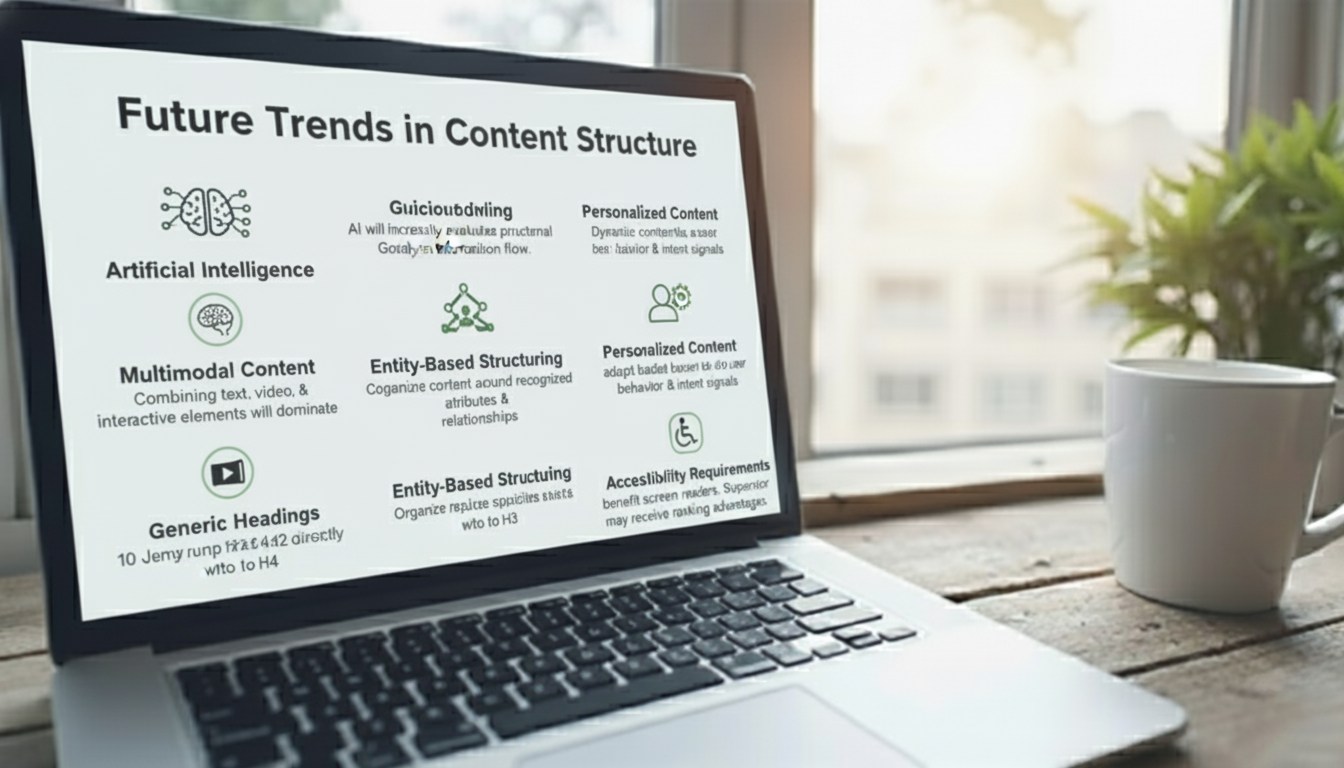
Artificial intelligence will increasingly evaluate structural patterns for ranking purposes. Google’s MUM algorithm analyses how information flows between sections to assess content quality and comprehensiveness.
Multimodal content structures combining text, video, and interactive elements will dominate user preferences. Readers expect varied formats within single articles rather than pure text experiences.
Entity based structuring will replace pure keyword optimisation. Organise content around recognised entities, their attributes, and relationships. This semantic approach aligns with how knowledge graphs interpret information.
Personalised content structures will adapt based on user behavior signals. Dynamic frameworks may reorder sections or emphasise different aspects based on reader intent signals and engagement patterns.
Accessibility requirements will shape structural standards more heavily. Proper heading hierarchies benefit screen readers and users with cognitive disabilities. Sites with superior accessibility structures may receive ranking advantages.
Final Thoughts
Most teams treat content structure as an afterthought: add headings, break up text, and hope pages perform. At DripRanks, we take a different approach. We don’t format content we engineer structure as part of a scalable SEO system.
Forensic page audits reveal where heading hierarchy, paragraph flow, and formatting choices block visibility and engagement. Intent mapped content frameworks guide readers and search engines seamlessly from problem awareness to solution adoption. The result? Pages rank faster, hold attention longer, and convert more consistently.
DripRanks specialises in system level content structuring that turns articles into predictable growth assets. Our frameworks make SEO measurable, repeatable, and revenue focused eliminating guesswork from content performance. Contact us to transform your content strategy with proven structural optimisation.