

Most websites lose 55% of visitors within 15 seconds because their content is too difficult to read. Google’s algorithm now prioritises user experience signals, making readability a direct ranking factor for search visibility.
Clear, scannable content keeps readers engaged longer, reduces bounce rates, and signals quality to search engines. When users stay on your page and interact with your content, Google interprets this as valuable and ranks you higher.
This guide will show you how to optimise content readability using proven techniques, industry tools, and real world examples. You’ll learn formatting strategies, sentence structure best practices, and how Drip Ranks helps clients achieve measurable ranking improvements through readability optimisation.
What is Content Readability?
Content readability measures how easily a reader can understand your written material. It considers sentence length, word complexity, paragraph structure, and visual formatting to determine comprehension difficulty.
The Flesch Reading Ease score and Flesch Kincaid Grade Level are standard metrics used to quantify readability. A score of 60 70 targets general audiences, while 80 90 suits elementary reading levels.
Readable content uses short sentences, common words, active voice, and logical flow. When readers grasp your message quickly, they engage more deeply with your content and take desired actions.
Why Content Readability Matters for SEO
Google’s algorithm evaluates user experience signals like dwell time, bounce rate, and pages per session. Content that’s easy to read naturally improves these metrics, sending positive ranking signals.
Studies show that content written at an 8th grade reading level receives 58% more engagement than college level writing. This increased interaction tells search engines your content satisfies user intent better than competitors.
Mobile users now represent 63% of all searches, and they demand quick, scannable information. Poor readability on mobile devices leads to immediate exits, which damages your search rankings over time.
Voice search queries continue growing, and assistants prefer content that matches natural speech patterns. Readable content aligns perfectly with conversational search behavior, increasing your chances of appearing in voice results.
How Content Readability Impacts User Behavior
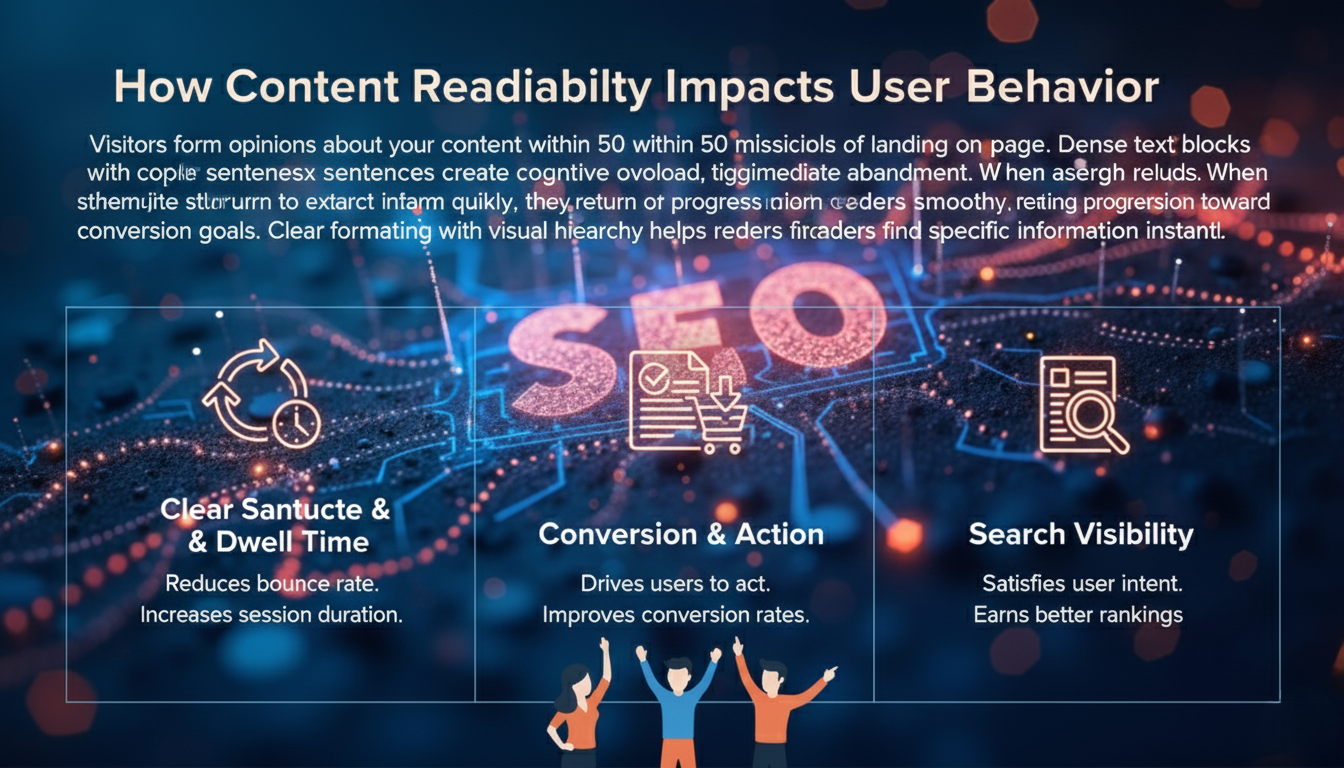
Visitors form opinions about your content within 50 milliseconds of landing on your page. Dense text blocks with complex sentences create cognitive overload, triggering immediate abandonment. Understanding How SEO Works helps you structure content so it’s both user friendly and search engine friendly.
When users struggle to extract information quickly, they return to search results seeking clearer alternatives. This behavior pattern increases your bounce rate and reduces average session duration, both negative ranking factors.
Readable content guides readers smoothly through your message, creating natural progression toward conversion goals. Users who understand your value proposition clearly are 73% more likely to complete desired actions.
Clear formatting with visual hierarchy helps readers find specific information instantly. This scannable structure satisfies informational queries effectively, which Google rewards with better visibility in search results.
Best Practices for Improving Content Readability
Write sentences between 15 20 words to maintain reader attention and comprehension. Mix sentence lengths to create rhythm, but keep 80% of sentences under 25 words for optimal flow. Understanding SEO Benefits helps you see why readability improves both user experience and search rankings.
Use active voice for 80% of your sentences to create directness and energy. “Google ranks readable content higher” is stronger than “Readable content is ranked higher by Google.”
Replace complex words with common alternatives that convey the same meaning. Choose “use” instead of “utilise” and “help” instead of “facilitate” to reduce reading friction.
Break content into short paragraphs of 2 3 sentences maximum. Long paragraph blocks intimidate readers and reduce scan ability, especially on mobile devices where screen space is limited.
Add descriptive subheadings every 200 300 words to create clear content sections. Subheadings allow readers to jump to relevant information quickly and improve your chances of ranking for featured snippets.
Incorporate bullet points and numbered lists for sequential information or multiple related points. Lists break visual monotony and present information in easily digestible chunks that readers can process rapidly.
Common Content Readability Mistakes to Avoid
Many writers mistakenly believe complex vocabulary demonstrates expertise, but it actually alienates most readers. Industry jargon should be explained or avoided unless targeting specialised professional audiences.
Using passive voice excessively makes sentences longer and obscures who performs actions. “Mistakes were made” is weaker and less clear than “The team made mistakes.”
Publishing giant text blocks without white space creates visual fatigue and encourages abandonment. Readers need breathing room between ideas to process information effectively and maintain engagement, which aligns with proper
eeat guidelines.
Neglecting mobile formatting represents a critical oversight since most users access content on smartphones. Sentences and paragraphs that look acceptable on desktop often become overwhelming walls of text on smaller screens.
Failing to define acronyms and technical terms assumes knowledge your audience may not possess. Always explain specialised terminology on first use to ensure universal comprehension.
Overusing transition phrases and filler words adds unnecessary length without adding value. Phrases like “it should be noted that” and “in order to” can usually be eliminated without losing meaning.
Tools and Resources for Measuring Readability
Hemingway Editor highlights complex sentences, passive voice, and difficult words with color coded feedback. This free tool provides instant readability scores and suggests specific improvements for clarity, making it useful as a content SEO tool.
Grammarly Premium offers real time readability scoring alongside grammar and style suggestions. The platform analyses tone, engagement, and delivery to help you match content to audience expectations, supporting SEO friendly writing.
Yoast SEO plugin includes readability analysis for WordPress users, checking sentence length, paragraph structure, and transition words. It provides actionable recommendations directly within your content editor, ensuring your pages are optimised for both SEO and user experience.
Readable.com processes entire documents and generates detailed readability reports using multiple scoring methods. The service tracks readability trends across your content library to identify improvement opportunities, helping maintain SEO consistency.
Google Search Console shows user engagement metrics like average time on page and bounce rate. These behavioral signals indicate whether your readability improvements are resonating with actual visitors, informing SEO optimisation strategies.
Microsoft Word includes built in readability statistics under the spelling and grammar check feature. After completing a spell check, view Flesch Reading Ease and Flesch Kincaid Grade Level scores instantly, making it an easy tool to support SEO content readability.
Advanced Readability Optimisation Techniques
Implement strategic keyword placement within naturally readable sentences rather than forcing awkward keyword density. Search engines now understand context and semantic relationships, rewarding natural language and effective semantic seo over keyword stuffing.
Use specific examples and concrete details instead of abstract concepts to illustrate key points. “Reduce bounce rate by 23%” is more compelling and memorable than “improve user engagement significantly.”
Create content hierarchies that match user search intent, placing the most critical information near the top. Answer the primary query within the first 100 150 words to satisfy quick information seekers.
Test different reading levels for various audience segments and content types. Product descriptions might target 6th grade level, while technical documentation serves advanced readers at 10th grade level.
Optimise for featured snippets by providing direct, concise answers to common questions in 40 50 word paragraphs. Structure these responses to stand independently while supporting your broader content narrative.
Add relevant images, charts, and visual elements to break text and illustrate complex concepts. Visual content increases comprehension by 323% and provides additional ranking opportunities through image search.
How Drip Ranks Optimises Content Readability
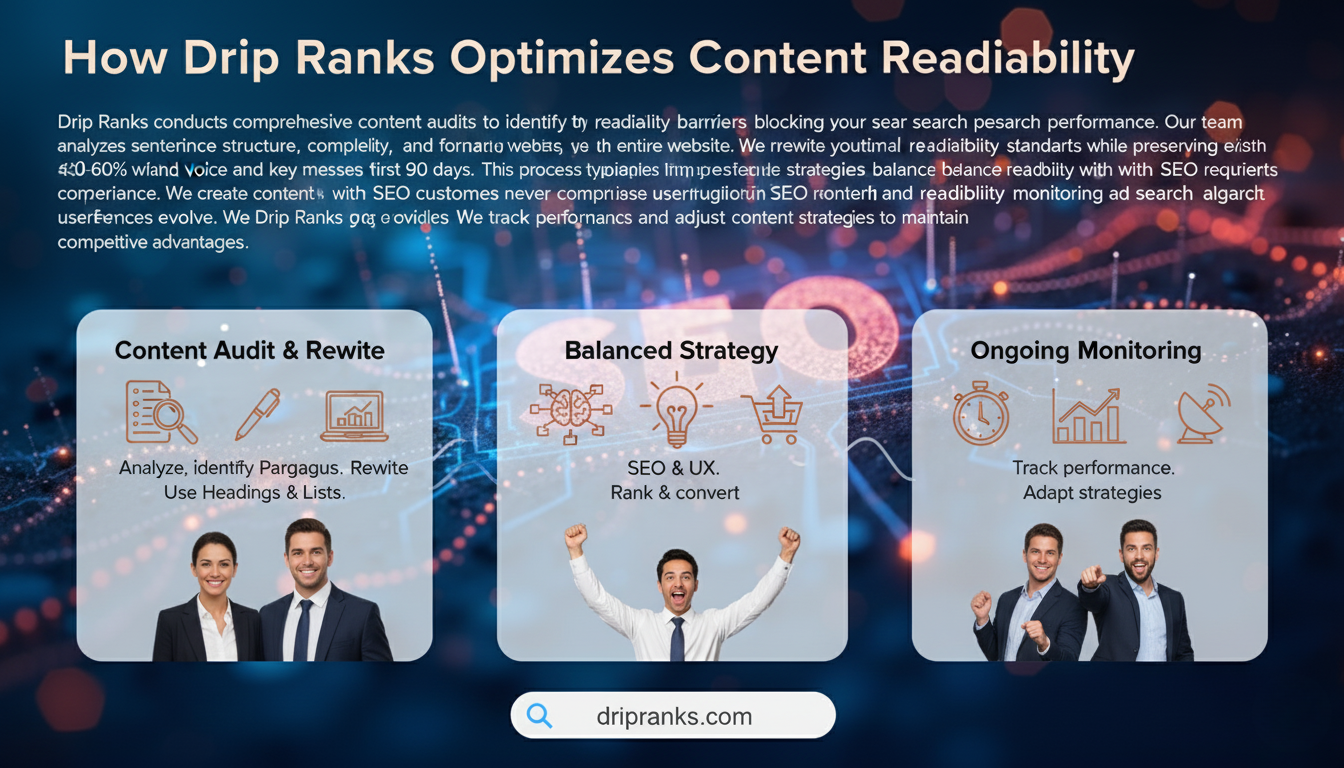
Drip Ranks conducts comprehensive content audits to identify readability barriers blocking your search performance. Our team analyses sentence structure, vocabulary complexity, and formatting across your entire website.
We rewrite existing content to meet optimal readability standards while preserving your brand voice and key messages. This process typically improves engagement metrics by 40 60% within the first 90 days.
Our content strategies balance readability with SEO requirements, ensuring keyword integration never compromises user experience. We create content that ranks well and converts visitors into customers through clear communication.
Drip Ranks provides ongoing readability monitoring and recommendations as search algorithms and user preferences evolve. We track performance metrics and adjust content strategies to maintain competitive advantages.
Final Thoughts
Most teams publish content assuming readability will take care of itself, then wonder why traffic stalls and conversions lag. At DripRanks, we approach readability as a performance system not a stylistic preference.
Forensic content audits identify where complexity blocks engagement and search visibility. Intent mapped readability frameworks transform dense copy into scannable, user first content that satisfies search intent and earns algorithmic preference. The result? Higher engagement, stronger rankings, and conversion rates that improve predictably over time.
DripRanks specialises in system level readability optimisation that turns content into a measurable growth asset. Our process makes clarity repeatable at scale so your SEO stops relying on guesswork and starts driving real pipeline. Contact us for a content audit and see how readable content accelerates organic performance.