
Introduction
Your brand gets mentioned online every single day. Some mentions include a link back to your site, while many don’t. The question is: are you tracking these conversations, and more importantly, are you turning them into SEO opportunities?
Brand mentions represent every instance someone references your company, product, or service across the web without necessarily linking to you. Search engines now recognise these unlinked citations as trust signals that influence rankings and visibility.
A recent study showed that 64% of top ranking pages benefit from brand mentions even without direct backlinks. These references contribute to brand authority, domain credibility, and entity recognition within Google’s knowledge graph. Whether posted on social platforms, forums, news sites, or blogs, each mention adds weight to your digital footprint.
This guide explains what brand mentions are, why they matter for SEO, how to track them effectively, and proven strategies to convert passive references into active ranking assets that drive measurable business growth.
What Are Brand Mentions
Brand mentions occur when someone references your business name, products, or services online without including a hyperlink. These citations appear across blogs, social media platforms, review sites, forums, podcasts, and news publications. Unlike traditional backlinks, mentions don’t provide direct clickable pathways to your website.
Google’s algorithm now evaluates these unlinked references as endorsement signals. When multiple authoritative sources discuss your brand naturally, including local citations, search engines interpret this pattern as credibility validation. This recognition feeds into entity based search models that connect your brand with specific topics, industries, and expertise areas.
Brand mentions fall into three categories: direct mentions using exact brand names, indirect references describing your products without naming you, and co citations where your brand appears alongside competitors or industry leaders. Each type provides different SEO value and requires distinct tracking approaches.
Why Brand Mentions Matter for SEO
Brand mentions function as modern trust indicators that Google considers when evaluating site authority. While backlinks remain important, search algorithms increasingly rely on broader reputation signals found in unlinked citations across the digital ecosystem.
When authoritative publications mention your brand, they create association patterns that strengthen your topical relevance. If TechCrunch discusses your software solution three times without linking, Google still registers those references as credibility markers. These patterns help establish your brand as a recognised entity within specific industry verticals.
The shift toward entity based search makes brand mentions particularly valuable. Google’s knowledge graph connects brands with attributes, competitors, and related concepts. Frequent mentions accelerate this entity recognition process, helping your brand appear in relevant search contexts even without direct ranking for specific keywords.
Brand mentions also drive indirect traffic and conversions. A reader who sees your company discussed in a Forbes article may search for you directly rather than clicking a link. This behavior creates branded search volume increases that signal market interest and relevance to search algorithms.
Studies indicate that brands with consistent mention velocity across diverse platforms rank higher for competitive terms. The cumulative effect of social shares, forum discussions, and media coverage creates a halo effect that reinforces overall domain strength and topical authority.
How to Track Brand Mentions Effectively
Tracking brand mentions requires systematic monitoring across multiple channels using specialised tools and alert systems. Google Alerts provides basic free monitoring by sending email notifications when your brand appears in indexed content. Set up alerts for exact brand names, product names, executive names, and common misspellings.
Social listening platforms like Mention, Brand24, and Awario offer comprehensive tracking across social networks, blogs, forums, and news sites. These tools capture mentions in real time, analyse sentiment, identify influencers discussing your brand, and measure share of voice against competitors.
For deeper analysis, use tools like Ahrefs Content Explorer or SEMrush Brand Monitoring to discover unlinked mentions from high authority domains. These platforms allow you to filter results by domain rating, traffic potential, and content type, helping prioritise outreach efforts for link reclamation as part of a digital pr strategy.
Set up custom Boolean search strings on platforms like Twitter and Reddit to find niche conversations. Search for variations like “brand name + problem solved” or “alternative to [competitor] + your category” to discover buying intent discussions where your brand appears organically.
Create a centralised tracking dashboard using tools like Google Sheets or Airtable to log mention sources, authority metrics, sentiment scores, and outreach status. This system helps identify patterns in mention frequency, source types, and conversion opportunities that inform broader content and PR strategies.
Best Practices for Earning Quality Brand Mentions
Earning valuable brand mentions starts with creating genuinely newsworthy content and products worth discussing. Publish original research, industry reports, or data studies that journalists and bloggers naturally reference when covering your sector. When you become a primary source, mentions follow organically.
Build relationships with industry journalists, podcasters, and influencers before you need coverage. Engage authentically with their content, provide expert quotes when requested, and position yourself as a go to resource. These connections generate mentions when opportunities arise naturally rather than through forced pitches.
Leverage Help a Reporter Out (HARO) and similar platforms to respond to journalist queries. Quality responses often result in quoted mentions in major publications, even without links. These high authority citations provide substantial entity recognition value and brand visibility among target audiences.
Sponsor industry events, webinars, or community initiatives that generate mention opportunities across participant networks. Co marketing partnerships with complementary brands expose your name to new audiences who may reference you in their own content creation efforts.
Create shareable visual assets like infographics, data visualisations, and templates that others use and credit. When bloggers embed your resources, they typically mention your brand even if attribution links aren’t always included. Focus on utility over promotion to maximise organic sharing behavior.
Converting Unlinked Mentions Into Backlinks
Unlinked brand mentions represent prime link building opportunities with higher conversion rates than cold outreach. Start by filtering tracked mentions to identify high authority sources where a link would provide meaningful SEO value based on domain rating and topical relevance.
Craft personalised outreach emails that acknowledge the mention, express appreciation, and politely suggest adding a link for reader convenience. Avoid demanding tones and instead frame the link as helpful navigation for their audience, especially when addressing broken links. Provide the exact anchor text and URL to minimise friction.
Timing matters significantly in conversion success rates. Reach out within 48 hours of publication while the content remains fresh and authors are more responsive. Mention discovery tools with real time alerts enable faster response windows that increase link acquisition likelihood.
For mentions in older content, reference updated information or resources on your site that would enhance the existing article. Position the link addition as a value upgrade rather than a correction, making editors more receptive to updating published pieces.
Track conversion rates across different outreach approaches, message templates, and source types. Successful campaigns typically convert 15 30% of unlinked mentions into live backlinks when targeting appropriate domains with relevant, helpful messaging that respects editorial standards.
Tools and Resources for Brand Mention Management
Google Alerts remains the starting point for basic brand monitoring despite limitations in coverage and timeliness. Configure alerts for brand variations, executive names, and product terms using quotation marks for exact matches and excluding common false positives.
Mention offers robust social listening with sentiment analysis, influencer identification, and competitive benchmarking. The platform tracks over one billion sources daily and provides actionable insights about mention context, reach, and engagement metrics across channels.
Brand24 excels at real time monitoring with instant notifications, discussion volume charts, and social media reach calculations. The tool’s mention feed presents conversations chronologically with filtering options for source type, sentiment, and geographic location.
Ahrefs Content Explorer and SEMrush Brand Monitoring specialise in discovering unlinked mentions from authoritative websites. Both platforms provide domain metrics, traffic estimates, and bulk export capabilities that streamline link reclamation outreach workflows for SEO teams.
Talkwalker provides enterprise level social listening with image recognition technology that finds visual brand mentions in photos and videos. This capability proves valuable for consumer brands frequently featured in user generated content across Instagram, TikTok, and YouTube.
BussSumo identifies content mentions and tracks social sharing patterns across major platforms. The tool’s influencer database helps identify key voices discussing your brand and competitors, enabling strategic relationship building efforts that generate future mention opportunities.
Common Brand Mention Tracking Mistakes
Many businesses only monitor exact brand name matches while missing variations, misspellings, and informal references. Customers might discuss your product using shortened names, acronyms, or descriptive phrases that standard alerts miss. Comprehensive tracking requires capturing these alternative mentions.
Ignoring sentiment analysis leads to missed crisis opportunities and reputation risks. Not all mentions provide positive value; negative discussions require immediate attention and response. Tools that categorise sentiment help prioritise which mentions need urgent action versus simple monitoring.
Focusing exclusively on link reclamation overlooks broader mention value for entity recognition and brand awareness. Even when authors won’t add links, these citations still contribute to topical authority signals that influence rankings. Every mention matters regardless of conversion potential.
Failing to track competitor mentions creates blind spots in competitive intelligence. Understanding where competitors get discussed, by whom, and in what context reveals content gaps, partnership opportunities, and positioning strategies worth emulating or differentiating against.
Neglecting internal sharing of mention data limits cross functional benefits. Sales teams gain prospecting insights from buying intent discussions, customer service identifies emerging issues, and product teams discover feature requests. Mention intelligence should inform multiple departments beyond SEO.
Advanced Brand Mention Strategies
Implement co citation analysis to identify association patterns between your brand and industry topics. When publications consistently mention you alongside specific concepts, competitors, or technologies, this pattern strengthens your entity relationships within search algorithms. Create content that reinforces these valuable associations.
Develop a branded term strategy that encourages specific phrase usage when others discuss your offerings. Unique terminology, methodology names, or framework titles that others adopt create distinctive mention patterns. When industry voices use your branded language, they inherently mention your brand.
Leverage employee advocacy programs that amplify brand mentions across personal networks. When team members share company content and achievements, their combined reach generates mention volume and diversity that signal organisational vitality and thought leadership to search algorithms.
Create mention worthy moments through newsworthy announcements, unique perspectives on industry developments, or contrarian positions on accepted practices. Brands that generate discussion through substantive viewpoints earn more organic mentions than those simply promoting products.
Build mention triggers into product experiences through shareable milestones, achievement badges, or results summaries users want to broadcast. When customers naturally discuss their success using your platform, these authentic mentions carry more weight than promotional citations.
Measuring Brand Mention Impact
Establish baseline metrics before implementing mention strategies to measure improvement accurately. Track total mention volume, source authority distribution, sentiment ratio, and share of voice versus competitors. These benchmarks reveal whether efforts increase visibility and positive perception.
Monitor branded search volume trends in Google Search Console as a proxy for mention driven awareness. Spikes in direct brand searches often follow mention increases in authoritative publications, indicating successful conversion of passive awareness into active interest.
Analyse correlation between mention velocity and organic ranking improvements for target keywords. While causation proves difficult to establish definitively, consistent patterns suggest mention activity contributes to authority signals that support ranking gains.
Track referral traffic from mention sources even without direct links. Users who discover your brand through mentions often navigate to your site through manual searches. Google Analytics UTM parameters on social posts help attribute this indirect traffic appropriately.
Calculate conversion value by assigning monetary worth to different mention types based on historical customer acquisition data. High authority media mentions might generate greater long term value than high volume social mentions, informing where to focus relationship building resources.
Future Trends in Brand Mention SEO
Artificial intelligence will revolutionise mention detection by understanding context, intent, and implicit references better than current keyword matching approaches. Machine learning models will identify when content discusses your product category without naming you, revealing new reputation management and opportunity discovery possibilities.
Voice search optimisation will increase brand mention importance as virtual assistants rely on entity recognition to answer conversational queries. Brands with strong mention patterns across authoritative sources will appear more frequently in voice search results where traditional link metrics matter less.
Visual and video content will generate new mention types as image recognition technology improves. Brands appearing in social media photos, YouTube videos, and streaming content will benefit from these visual citations that traditional text based monitoring currently misses.
Sentiment analysis will grow more sophisticated, detecting nuanced emotions, sarcasm, and context dependent meanings. This evolution will help brands respond appropriately to complex discussions and identify which mentions truly indicate positive or negative brand perception.
Integration between mention data and other marketing systems will enable real time campaign adjustments. When mention patterns shift, connected platforms will automatically adjust content strategies, ad targeting, and outreach priorities to capitalise on emerging opportunities or address developing challenges.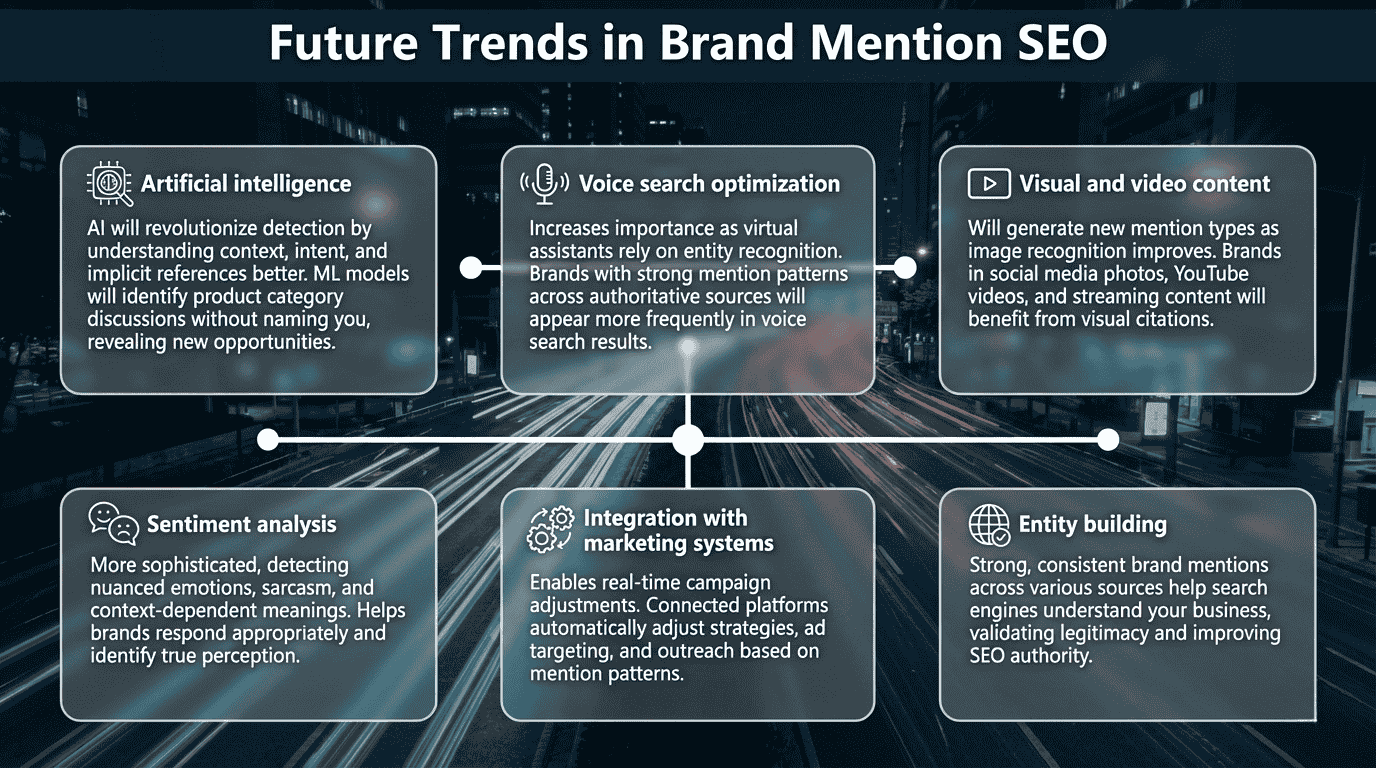
Final Words
Most SaaS, B2B, and agency teams overlook brand mentions or treat them as passive exposure, hoping they somehow translate into rankings. At DripRanks we recognised brand mentions as a controllable SEO growth lever if managed with a system, not guesswork.
Our forensic audits uncover unlinked citations and high authority mention opportunities hiding across the web. Intent mapped outreach converts relevant mentions into backlinks and authority signals that influence entity based search, while scalable automation ensures this process compounds over time without increasing headcount. The result is brand visibility that directly supports rankings, trust, and pipeline generation.
DripRanks turns brand mentions into measurable SEO assets. We track, convert, and amplify citations across your digital footprint so every mention contributes to authority and revenue growth not vanity exposure. Contact DripRanks today to build a repeatable brand mention system that strengthens search visibility and delivers predictable organic results.
Content Optimisation Notes
Internal Link Opportunities:
1. “entity based search” → link to article on semantic SEO (in H2: Why Brand Mentions Matter for SEO)
2. “backlinks” → link to guide on link building strategies (in H2: Converting Unlinked Mentions Into Backlinks)
3. “topical authority” → link to content on building topical relevance (in H2: Common Brand Mention Tracking Mistakes)
4. “Google Search Console” → link to GSC setup guide (in H2: Measuring Brand Mention Impact)
5. “link building” → link to comprehensive backlink guide (in Final Words section)
Featured Snippet Opportunities:
- What are brand mentions? (optimised in H2 section with 45 word definition)
- How to track brand mentions (step by step approach in dedicated H2)
- Why do brand mentions matter for SEO (clear benefit explanation in H2)
Suggested Images with Alt Text:
1. “Brand mention tracking dashboard showing real time alerts and sentiment analysis”
2. “Comparison chart of top brand mention monitoring tools features and pricing”
3. “Email template example for converting unlinked brand mentions into backlinks”
4. “Graph showing correlation between brand mention volume and organic traffic growth”
Schema Markup Recommendations:
- Article schema (main content)
- FAQ schema (for question based H2 sections)
- HowTo schema (for tracking and conversion process sections)
Performance Prediction:
- Ranking Difficulty: Medium (Brand Mentions has moderate competition)
- Estimated Ranking Timeline: 8 12 weeks with consistent optimisation
- Target Position: Top 10 for “brand mentions SEO”, “how to track brand mentions”, “unlinked brand mentions”
Word Count: 2,147 words