
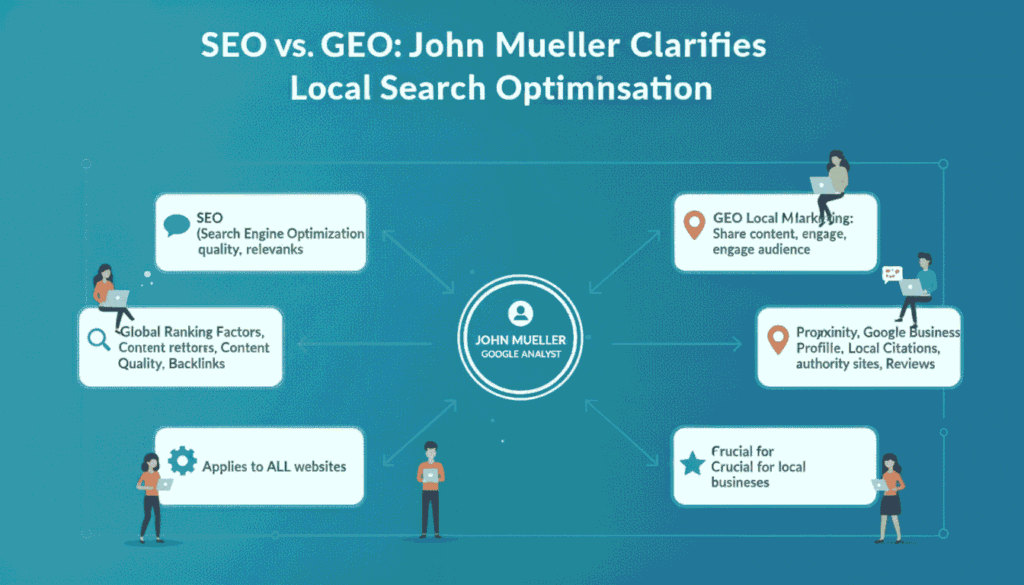

Google’s John Mueller has weighed into the ongoing debate about whether local search optimisation should be called GEO (Geographical Engine Optimisation) rather than simply SEO, providing clarity on terminology that’s dividing the digital marketing community.
The discussion emerged after marketers questioned whether local search strategies differ significantly enough from traditional SEO to warrant distinct naming. Mueller’s response highlights the evolving complexity of search optimisation and how geographic targeting has become a specialised discipline.
The GEO vs SEO Distinction
The term GEO has gained traction among local search specialists who argue that optimising for location-based queries requires fundamentally different approaches than standard SEO practices. These include managing Google Business Profiles, building local citations, and targeting geo-specific keywords.
Mueller acknowledged that whilst local search optimisation involves unique elements, it remains part of the broader SEO ecosystem. “It’s still search engine optimisation, whether you’re focusing on local or global visibility,” he noted, though he recognised the specialised knowledge required for effective local search strategies.
The debate reflects growing recognition that local businesses face distinct challenges. Optimising for “near me” searches, managing review signals, and maintaining consistent NAP (Name, Address, Phone) data across directories requires expertise beyond traditional organic search tactics.
Why the Terminology Matters
For businesses and agencies, the SEO vs GEO discussion isn’t merely semantic. It highlights how search marketing has fragmented into specialised disciplines, each demanding specific technical knowledge and strategic approaches.
Local search optimisation now encompasses Google Maps ranking factors, local pack algorithms, and proximity signals that don’t apply to traditional organic search. This complexity has led some practitioners to adopt GEO as shorthand for their specialisation, similar to how technical SEO or e-commerce SEO define specific practice areas.
However, Mueller’s perspective suggests Google views these as variations within SEO rather than entirely separate disciplines. This matters for how businesses allocate resources and evaluate agency expertise.
Practical Implications for Marketers
Whether you call it SEO or GEO, the practical reality remains unchanged: businesses targeting local customers need comprehensive strategies covering both traditional ranking factors and location-specific signals.
Effective local search requires optimising on-site content with geographic keywords, building authoritative local backlinks, maintaining accurate business listings, and actively managing customer reviews. These elements work alongside technical SEO fundamentals like site speed, mobile responsiveness, and structured data markup.
The key takeaway from Mueller’s comments is that terminology matters less than understanding which optimisation tactics drive results for your specific business goals. Local businesses shouldn’t overlook traditional SEO fundamentals whilst pursuing geographic visibility, nor should broader SEO strategies ignore local search opportunities.
About DripRanks: Your Local SEO Partner in Dubai
At DripRanks, we don’t just follow the trends – we help you lead them. As one of Dubai’s top-rated SEO agencies, we specialise in data-driven strategies that boost visibility and conversions, whether you’re targeting local searches or global markets.
Our team understands that effective search optimisation requires both technical expertise and strategic geographic targeting. We combine traditional SEO best practices with advanced local search tactics to deliver measurable results.