

Over 70% of users abandon websites they find confusing or difficult to navigate. Poor site structure doesn’t just frustrate visitors. It prevents search engines from understanding your content hierarchy and ranking your pages effectively.
Modern websites compete in an environment where Google prioritises user experience signals alongside traditional ranking factors. Your site architecture determines how easily both users and crawlers can access information. A well planned structure reduces bounce rates, increases page views, and signals topical authority.
This guide covers everything you need to know about building site architecture that ranks. You’ll discover practical strategies, avoid common pitfalls, and learn how industry leaders structure their websites for maximum visibility. Whether you’re launching a new site or restructuring an existing one, these proven techniques will transform your digital presence. Drip Ranks specialises in helping businesses create SEO optimised site structures that convert visitors into customers.
What is Site Architecture?
Site architecture refers to how your website pages are organised, linked, and structured. It creates a hierarchy that defines relationships between your homepage, category pages, and individual content pieces. This organisational framework guides both human visitors and search engine crawlers through your content.
Think of site architecture as your website’s blueprint. Just as buildings need strong foundations, websites require logical structures that support growth. A flat architecture might place most pages two or three clicks from the homepage, while deeper architectures create more hierarchical layers.
Search engines use your site structure to understand content relationships and topical relevance. When pages are properly organised and internally linked, crawlers can efficiently discover, index, and rank your content. Poor architecture leaves valuable pages orphaned or buried too deep to receive authority.
Why Site Architecture Matters for SEO
Effective site architecture directly impacts how search engines crawl and index your content. Google’s crawl budget allocates limited resources to each website. Poor structure wastes this budget on low value pages while leaving important content undiscovered.
User experience metrics like bounce rate and session duration send ranking signals to search engines. Visitors who easily find relevant information stay longer and engage more. This positive behavior signals content quality and relevance, improving your rankings over time.
Site structure also distributes link equity throughout your website. Strategic internal linking passes authority from high performing pages to newer or underperforming content. This distribution helps entire sections rank better rather than relying on individual page strength alone.
Core Components of Effective Site Architecture
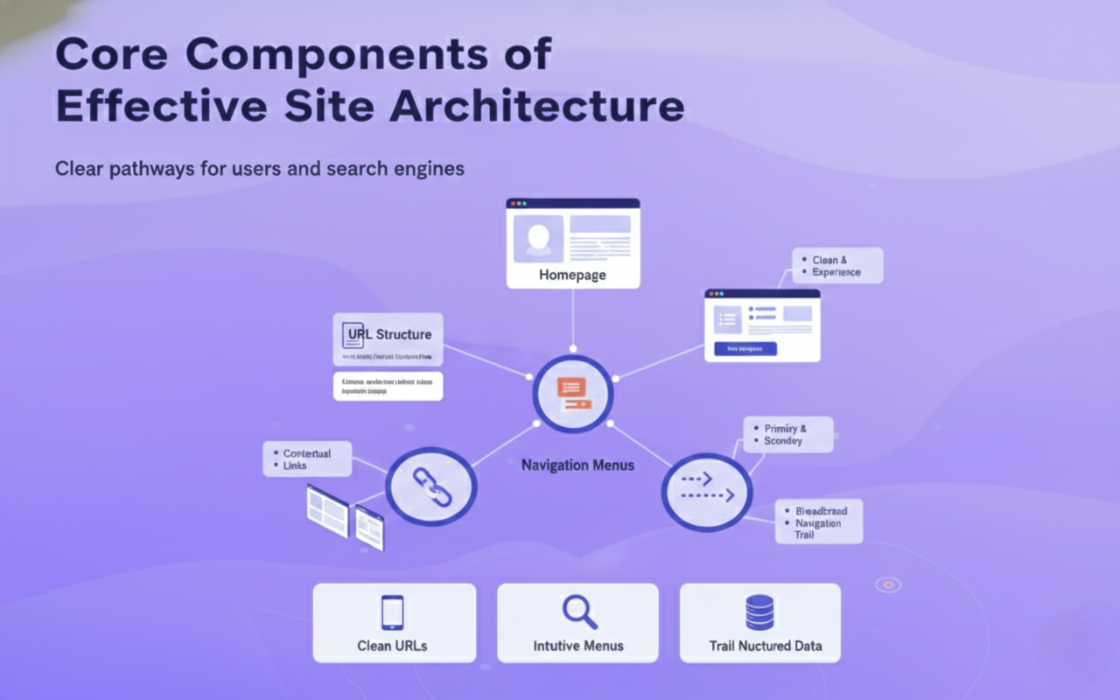
Your URL structure should reflect your content hierarchy clearly and concisely. Clean URLs help users understand page context before clicking. Descriptive paths like “website.com/services/seo audits” communicate more than generic parameters or session IDs.
Navigation menus serve as roadmaps for both users and crawlers. Primary navigation should highlight your most important categories and services. Secondary menus can address specific user needs without cluttering your main navigation structure.
Internal linking creates pathways between related content pieces. Contextual links within content carry more weight than footer or sidebar links. Strategic linking helps distribute authority while keeping users engaged with relevant information across multiple pages.
Breadcrumb navigation provides secondary navigation paths and reinforces your hierarchy. These trails show users their current location within your site structure. Search engines use breadcrumbs to understand parent child relationships between pages and may display them in search results.
How to Plan Your Site Architecture
Start by conducting thorough keyword research to understand search intent and topical clusters. Group related keywords into categories that reflect how users think about your industry. This research forms the foundation for your content hierarchy and navigation structure.
Create a visual sitemap before building or restructuring your website. Tools like flowcharts or mind mapping software help visualise relationships between pages. This planning phase identifies potential issues before they become structural problems affecting your SEO performance.
Consider user personas and customer journeys when organising content. Different visitors arrive with different goals and awareness levels. Your structure should accommodate both newcomers seeking basic information and experts looking for specific technical details.
Test your planned structure with real users before full implementation. Card sorting exercises reveal how your target audience naturally categorises your content. These insights often uncover gaps between how you think about your services and how customers actually search.
Best Practices for SEO Friendly Site Architecture
Keep your architecture as flat as possible without sacrificing organisation. Most pages should be accessible within three clicks from your homepage. This accessibility ensures important content receives regular crawls and maintains link equity distribution throughout your site.
Implement a logical hierarchy that flows from broad topics to specific subtopics. Your homepage links to main category pages, which link to subcategories, which finally link to individual content pieces. This pyramid structure mirrors how users naturally navigate from general to specific information.
Use descriptive anchor text for internal links that includes relevant keywords. Avoid generic phrases like “click here” or “read more” that provide no context. Descriptive anchors help search engines understand the linked page’s topic and improve relevance signals.
Create topic clusters by linking related content pieces to pillar pages. This hub and spoke model establishes topical authority on broad subjects. Cluster pages link back to the pillar page, creating a network that signals comprehensive coverage.
Optimise your XML sitemap to reflect your architectural priorities. While sitemaps help crawlers discover pages, they shouldn’t compensate for poor internal linking. Use priority and change frequency tags judiciously to guide crawler attention toward your most valuable content.
Common Site Architecture Mistakes
Many websites create orphan pages that lack internal links from other pages. These isolated pages rarely rank well because crawlers struggle to discover them. Every page should receive at least one internal link from another page within your site.
Overly complex navigation structures confuse users and dilute link equity. Mega menus with dozens of options overwhelm visitors and create crawl inefficiencies. Simplify your navigation to highlight your most important categories and services without cluttering the interface.
Duplicate content issues often stem from poor URL management and parameter handling. Pages accessible through multiple URLs split ranking signals and waste crawl budget. Implement canonical tags and proper redirects to consolidate signals toward your preferred URLs.
Deep architecture buries valuable content too many clicks from your homepage. Pages requiring four or more clicks receive less authority and fewer crawler visits. Flatten your structure or create strategic internal links to bring important content closer to the surface.
Ignoring mobile architecture creates navigation challenges on smaller screens. Responsive designs should maintain clear hierarchies without relying solely on hover states. Mobile first indexing means Google primarily uses your mobile structure to determine rankings.
Tools for Analysing Site Architecture
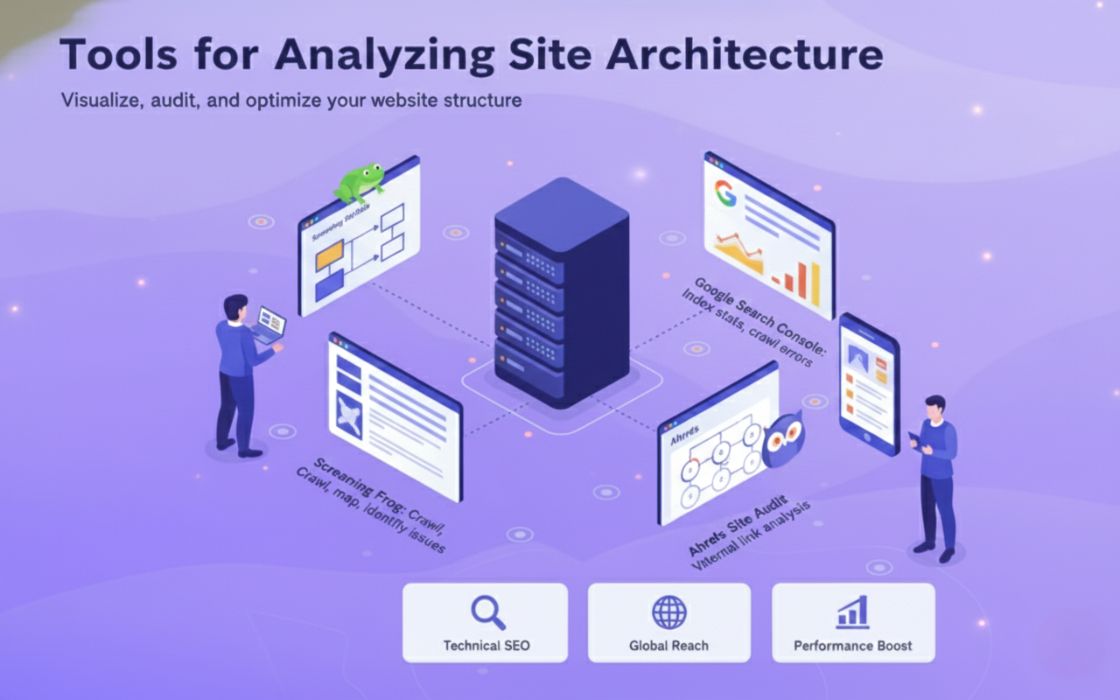
Screaming Frog SEO Spider crawls your website like search engines do. This tool reveals orphan pages, broken links, and crawl depth issues. The visual site architecture diagram shows how pages connect and where structural problems exist.
Google Search Console provides crawl stats and index coverage reports. These insights reveal which pages Google discovers and any crawling errors encountered. The URL Inspection tool tests specific pages to verify indexing status and architectural accessibility.
Ahrefs Site Audit examines your internal linking structure and identifies optimisation opportunities. The tool calculates internal PageRank to show which pages receive the most authority. Link opportunity reports suggest where strategic internal links could improve content distribution.
Sitebulb offers advanced crawling capabilities with visual representations of your architecture. The tool identifies technical issues affecting crawlability while providing actionable recommendations. Interactive visualisations help you understand complex structural relationships at a glance.
Advanced Site Architecture Strategies
Implement faceted navigation carefully to avoid creating thousands of indexable parameter URLs. Use robots.txt or meta robots tags to prevent crawlers from indexing filter combinations. Allow indexing only for valuable filter combinations that target specific search queries.
Create location based architecture for multi location businesses without duplicating content. Use city specific landing pages with unique local information rather than template pages. This approach targets local search queries while maintaining structural clarity.
Develop separate architectures for different user segments when appropriate. B2B and B2C audiences often require different content pathways and information hierarchies. Segmented structures improve relevance without forcing all users through the same journey.
Monitor and adapt your architecture as your business evolves. Regular audits identify structural debt from outdated categories or content silos. Prune or consolidate underperforming sections to maintain a lean, efficient structure that serves current business goals.
Measuring Site Architecture Success
Track average crawl depth across your website using server logs or analytics tools. Decreasing average depth indicates improved architecture efficiency. Pages moving closer to your homepage typically experience improved indexing and ranking performance.
Monitor internal search queries to identify navigation gaps in your structure. Users searching your site reveal content they couldn’t find through normal navigation. These queries highlight opportunities to improve your information architecture and internal linking.
Analyse page level metrics like bounce rate and time on page across different architectural levels. Category pages with high engagement indicate effective organisation, while poor metrics suggest structural confusion. Use these insights to refine navigation and internal linking strategies.
Track organic visibility improvements for pages receiving architectural enhancements. Compare rankings before and after restructuring to measure impact. Significant changes often require three to six months to fully manifest in search results.
Site Architecture and Technical SEO
Proper site architecture supports efficient crawling and indexing across your entire domain. Strategic use of robots.txt guides crawlers away from low value pages like admin areas or search result pages. This guidance preserves crawl budget for your most important content.
Schema markup integration becomes easier with clear architectural hierarchies. Breadcrumb schema, organisation schema, and sitelink search box markup all rely on structured site organisation. Proper implementation helps search engines display rich results that improve click through rates.
Page speed optimisation benefits from streamlined architecture that reduces unnecessary redirects. Each redirect adds latency that frustrates users and wastes resources. Clean URL structures and logical hierarchies minimise redirect chains while improving overall performance.
Final Thoughts
Most SaaS, B2B, and agency teams treat site architecture like a one-time setup: build a hierarchy, hope it helps rankings, and wonder why SEO results aren’t predictable. At Drip Ranks, we knew there had to be a better way. So we built a system, not a service.
Forensic audits uncover your highest ROI opportunities, showing exactly where your site structure can improve crawlability, user experience, and conversion potential. Intent-mapped strategies ensure every page supports the buyer journey, while scalable implementation multiplies results without increasing headcount. The difference? Your SEO becomes measurable, repeatable, and revenue-focused, not a black box that relies on guesswork.
Drip Ranks helps businesses build SEO optimised site architectures that drive measurable results. Our team analyses your current structure, identifies improvement opportunities, and implements proven strategies that boost rankings. Contact us today for a comprehensive site architecture audit that uncovers hidden opportunities in your digital foundation.