


Most website owners struggle with getting their pages indexed by Google. Your content might be excellent, but search engines cannot find or rank what they cannot crawl. This creates a frustrating gap between effort and results. An XML sitemap solves this problem by providing search engines with a clear roadmap of your website’s structure and content.
Without a proper XML sitemap, search engines waste crawl budget on low-value pages. They might miss your most important content entirely. This becomes especially critical for large websites, new domains, or sites with complex architectures. Recent Google updates emphasise the importance of clear site structure for ranking success.
This guide explains everything you need to know about XML sitemaps. You will learn what they are, why they matter, and how to create optimised versions. We will cover technical setup, common mistakes, and advanced strategies that professional SEO agencies use. By the end, you will understand how to leverage XML sitemaps for better search visibility.
What is an XML Sitemap
An XML sitemap is a file that lists all important URLs on your website. It uses Extensible Markup Language to communicate with search engines like Google and Bing. This file tells crawlers which pages exist, when they were updated, and how they relate to each other, while also indirectly supporting better site speed by helping search engines crawl efficiently.
The sitemap acts as a guide for search engine bots. It helps them discover pages that might not be easily accessible through normal crawling. This becomes particularly valuable for pages buried deep in your site architecture or newly published content without many internal links.
Most XML sitemaps follow a standard protocol defined by sitemaps.org. The file includes URLs along with metadata like last modification date, change frequency, and priority. Search engines use this information to make smarter crawling decisions and allocate resources efficiently.
Why XML Sitemaps Matter for SEO
XML sitemaps directly impact how search engines discover and index your content, which is a core part of what is SEO. They provide crawlers with structured information that improves crawling efficiency. This means your important pages get indexed faster and more reliably than sites without optimised sitemaps.
For new websites, sitemaps accelerate the indexing process significantly. Google might take weeks to discover all pages through natural crawling alone. A properly submitted XML sitemap can reduce this timeframe to just days. This creates a competitive advantage when launching new content or entire websites.
Large websites with thousands of pages benefit even more from XML sitemaps. Search engines have limited crawl budgets for each domain. By prioritising important URLs in your sitemap, you guide crawlers toward high-value content. This prevents wasted resources on duplicate pages, filters, or low-priority sections.
Websites with frequent content updates need XML sitemaps to communicate changes. News sites, blogs, and ecommerce platforms publish new pages daily. The sitemap’s last modified date tells search engines which pages need recrawling. This ensures fresh content gets indexed quickly without requiring manual interventio
How XML Sitemaps Work with Search Engines
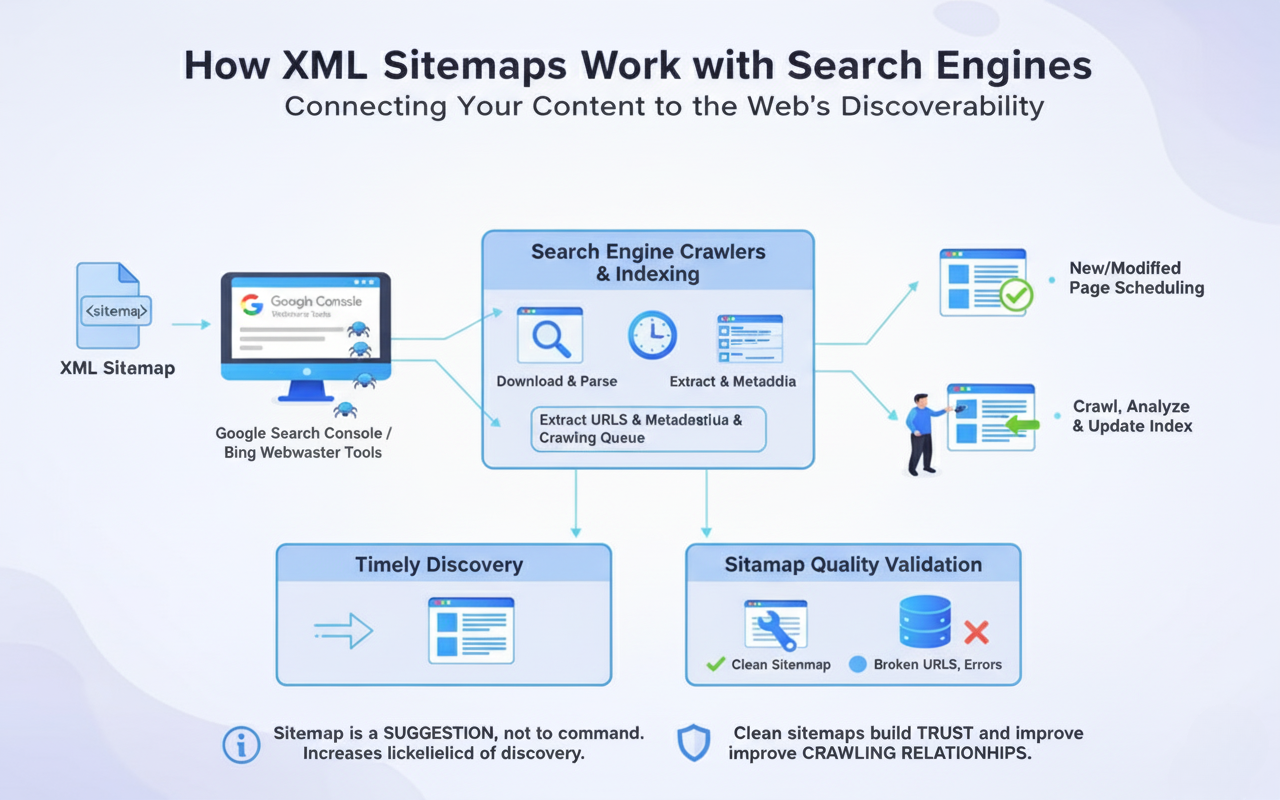
Search engines use XML sitemaps as one signal among many ranking factors. When you submit a sitemap through Google Search Console or Bing Webmaster Tools, crawlers download and parse the file. They extract URLs and metadata to build a crawling queue based on priority and resources.
Google’s crawler evaluates each URL against its existing index. If the page is new or shows a recent modification date, it gets scheduled for crawling. The crawler then visits the page, analyses content, and updates the index accordingly. This process happens continuously as your sitemap changes.
The sitemap does not guarantee indexing or ranking improvements. Google clearly states that submitting a sitemap is a suggestion, not a command. However, it significantly increases the likelihood of timely discovery. Pages listed in sitemaps typically get crawled faster than orphaned pages without internal links.
Modern search engines also validate sitemap quality during processing. They check for broken URLs, redirect chains, and formatting errors. Clean sitemaps signal professional site management and technical SEO competence. This indirectly supports better crawling relationships and trust signals with search engines.
Best Practices for Creating XML Sitemaps
Start by including only indexable URLs in your sitemap. Exclude pages blocked by robots.txt, noindex tags, or canonical redirections. Including these URLs wastes crawler resources and signals poor technical SEO. Your sitemap should represent the cleanest version of your site architecture.
Keep individual sitemap files under 50MB and 50,000 URLs. Larger sites should use sitemap index files that reference multiple smaller sitemaps. This modular approach improves processing speed and makes maintenance easier. Organise sitemaps by content type like blog posts, product pages, or landing pages.
Always use absolute URLs with proper protocols. Include the full path starting with https://yourdomain.com rather than relative paths. This prevents confusion and ensures crawlers access the correct versions. Consistent URL formatting across your sitemap prevents duplicate content issues.
Update your sitemap automatically whenever content changes. Most content management systems offer plugins or built-in features for dynamic sitemap generation. Manual updates create maintenance burdens and often lead to outdated information. Automation ensures your sitemap always reflects current site structure.
Set realistic priority values between 0.0 and 1.0 for each URL. Reserve 1.0 for your most important pages like homepage or key landing pages. Use 0.8 for category pages and 0.6 for blog posts. Avoid setting everything to 1.0 as this removes any meaningful prioritisation signal.
Common XML Sitemap Mistakes to Avoid
Many websites include paginated pages or filter variations in their sitemaps. This clutters the file with low-value URLs that waste crawl budget. Use canonical tags to consolidate similar pages and exclude variations from your sitemap. Focus only on primary versions of content.
Broken or redirected URLs frequently appear in poorly maintained sitemaps. These errors force crawlers to waste time following redirect chains or hitting 404 pages. Regularly audit your sitemap against actual site status. Remove dead links and update redirected URLs to their final destinations.
Some sites submit multiple sitemaps with overlapping URLs. This creates confusion about which version should be indexed. Maintain a clear hierarchy using sitemap index files. Each URL should appear in only one location to provide unambiguous guidance to crawlers.
Forgetting to submit your sitemap to search engines is surprisingly common. Creating the file accomplishes nothing without proper submission through Google Search Console and Bing Webmaster Tools. Verify submission status and monitor for processing errors regularly.
Many developers include URLs with parameters or session IDs in sitemaps. These dynamic URLs often lead to duplicate content issues. Use URL parameters tool in Search Console to inform Google how to handle variables. Clean your sitemap to show only canonical parameter-free URLs.
Tools and Resources for Sitemap Management
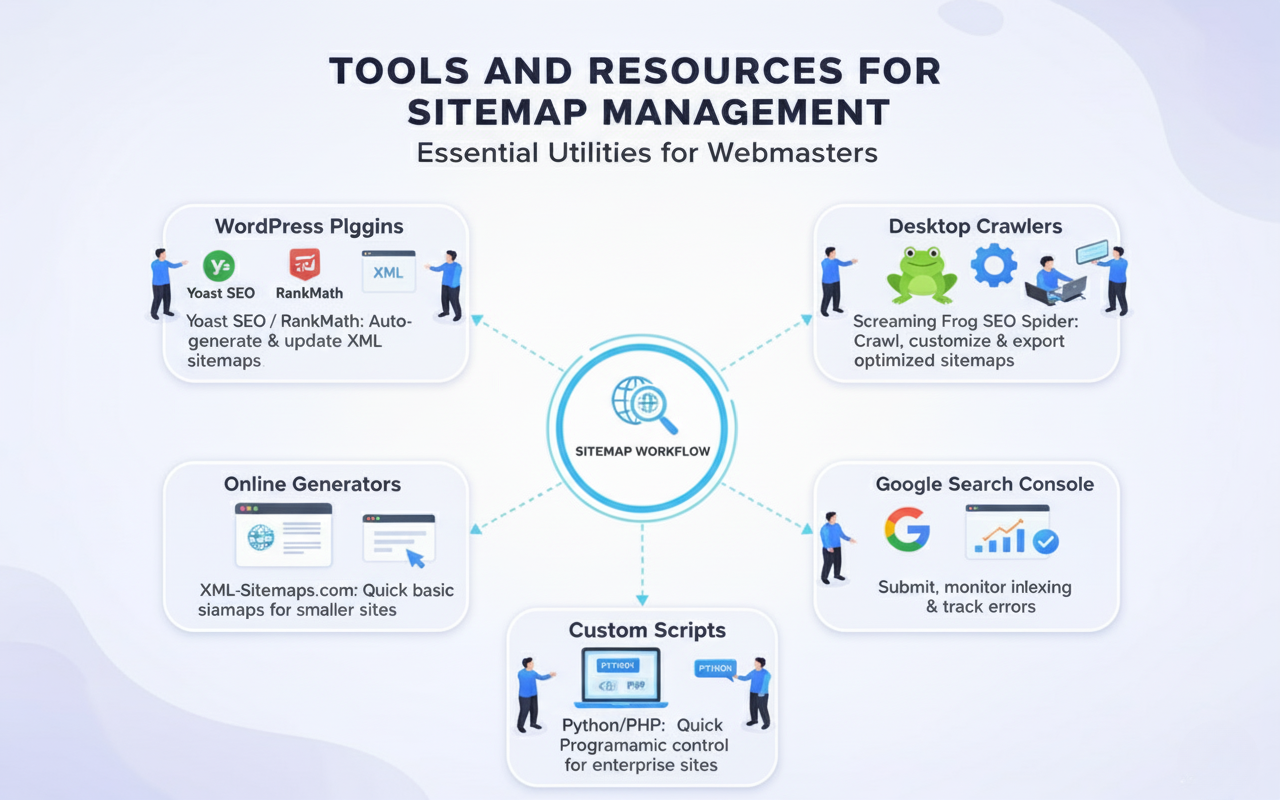
WordPress users benefit from plugins like Yoast SEO or RankMath for automatic sitemap generation. These SEO tools create clean XML files and update them with every content change. They also handle technical details like escaping special characters and proper XML formatting.
Screaming Frog SEO Spider offers powerful sitemap creation for any website. This desktop tool crawls your site and generates optimised sitemaps based on your specifications. You can customise inclusion rules, set priorities, and export production-ready files in minutes.
Google Search Console provides sitemap submission and monitoring capabilities. After adding your site property, navigate to the Sitemaps section. Submit your sitemap URL and track indexing status over time. The interface shows errors, warnings, and successful indexing counts.
Online generators like XML-Sitemaps.com work for smaller sites without technical resources. These free SEO tools crawl your domain and produce basic sitemap files. They lack customisation options but provide a quick solution for simple websites. Validate output before submission to ensure quality.
Technical teams often use custom scripts in Python or PHP for enterprise sitemaps. These programmatic approaches offer complete control over URL selection and metadata. They integrate with content databases to ensure real-time accuracy for large scale operations.
Advanced XML Sitemap Strategies for Enterprise Sites
Large ecommerce platforms should create separate sitemaps for product categories. This segmentation helps search engines understand site structure and prioritise high-converting pages. Include separate files for blog content, informational pages, and transactional sections.
Implement lastmod dates using accurate timestamps from your database. This tells Google exactly when content changed, triggering faster recrawling. Sites with stale lastmod dates miss opportunities for timely indexing. Automated systems should pull modification dates from your content management system.
Consider using video and image sitemaps for rich media content. These specialised formats provide additional metadata like video duration, thumbnail URLs, and image captions. They improve visibility in video search results and Google Images. Structure them separately from your main URL sitemap.
Multilingual websites need hreflang annotations within their sitemaps. This helps search engines serve the correct language version to users. Include hreflang tags for each URL variant pointing to alternate language versions. Proper implementation prevents duplicate content issues across international domains.
Monitor sitemap coverage ratios in Search Console regularly. This metric shows the percentage of submitted URLs actually indexed. Low coverage indicates technical issues, quality problems, or crawl budget constraints. Investigate and resolve barriers preventing full indexing of your important content.
Future Trends and XML Sitemap Evolution
Search engines continue refining how they use sitemap signals. Google’s John Mueller has suggested that sitemaps might become less critical as AI-powered crawling improves. However, they remain the most reliable method for communicating site structure and delivering clear SEO benefits. Maintain optimised sitemaps regardless of future algorithm changes.
Mobile-first indexing emphasises the need for clean, fast-loading pages listed in sitemaps. Ensure all URLs in your sitemap provide excellent mobile SEO experiences. Pages that fail Core Web Vitals metrics may get deprioritised even when properly submitted.
Structured data integration with sitemaps is gaining traction. Some platforms now include schema markup references within sitemap files. This hybrid approach helps search engines understand content types before crawling. Expect more sophisticated metadata options in future sitemap specifications.
Real-time sitemap updates through push notifications may become standard. Rather than waiting for crawlers to check periodically, sites could notify search engines immediately when content changes. This would enable near-instant indexing for time-sensitive content like breaking news or flash sales.
Final Thoughts
XML sitemaps remain a fundamental component of technical SEO. They bridge the gap between your content and search engine discovery. Proper implementation ensures your most valuable pages get crawled, indexed, and ranked efficiently.
Creating an optimised sitemap requires attention to detail and ongoing maintenance. Follow best practices around URL selection, file structure, and metadata accuracy. Avoid common mistakes that waste crawl budget or confuse search engines.
If you need expert help optimising your XML sitemap strategy, contact Drip Ranks today. Our technical SEO specialists analyse your site architecture and implement enterprise-grade sitemap solutions. We ensure search engines can easily discover and index your content. Get your free SEO audit now and start ranking faster with properly configured XML sitemaps that drive measurable results.