


Have you noticed visitors leaving your website before it even loads? Recent studies show that 53% of mobile users abandon sites that take longer than three seconds to load. This single metric can make or break your online success.
Google confirmed in 2021 that page experience signals, including site speed, became official ranking factors. Faster websites consistently outrank slower competitors, earn more conversions, and keep users engaged longer. Your website’s loading time directly affects your bottom line.
Site speed improvements can increase conversion rates by up to 74% according to Portent’s research. Every second of delay reduces customer satisfaction and revenue potential. Understanding how to measure and optimise your site’s performance is no longer optional.
This guide reveals exactly how site speed impacts search rankings, which metrics matter most, and proven strategies to accelerate your website. You’ll learn actionable techniques that deliver measurable results within weeks.
What is Site Speed?
Site speed refers to how quickly your web pages load and become fully interactive for users. This measurement includes the time from initial request to complete rendering of all content, images, and scripts, which is a key factor in understanding What is SEO and how search engines evaluate user experience.
Different metrics measure various aspects of loading performance. First Contentful Paint shows when the first element appears, while Time to Interactive measures when users can actually engage with your page. These metrics collectively determine user experience quality.
Google’s core web vitals framework focuses on three specific measurements. Largest Contentful Paint tracks when main content loads, First Input Delay measures interactivity responsiveness, and Cumulative Layout Shift evaluates visual stability. These standardised benchmarks help you compare performance objectively.
Why Site Speed Matters for SEO
Search engines prioritise websites that deliver superior user experiences. Google explicitly confirmed that page speed became a direct ranking factor for mobile searches in 2018 and for desktop searches even earlier.
Faster websites receive preferential treatment in search results because they satisfy user intent more effectively. When two pages offer similar content quality, the faster loading option typically ranks higher. This competitive advantage compounds over time as faster sites accumulate more engagement signals.
Page speed also influences critical user behavior metrics that search engines monitor. Bounce rates drop significantly on faster sites, while time on site and pages per session increase. These positive engagement signals reinforce your SEO performance across all rankings.
Mobile performance carries even greater weight since Google switched to mobile first indexing. Your mobile site speed now determines how Google evaluates and ranks your entire domain. Slow mobile experiences actively harm your visibility across all devices.
How Site Speed Affects User Experience
Users form first impressions within milliseconds of page load. A delay of just one second can reduce customer satisfaction by 16% and decrease conversions by 7% according to Aberdeen Group research.
Modern consumers expect instant gratification and have sero patience for slow websites. Studies reveal that 79% of shoppers who experience performance issues say they won’t return to that site. Your loading speed directly determines whether visitors become customers or competitors’ customers.
Slow pages create frustration that damages brand perception and trust. Users associate sluggish performance with unprofessionalism and poor quality, regardless of your actual offerings. Speed has become a proxy for credibility in users’ minds.
Key Metrics for Measuring Site Speed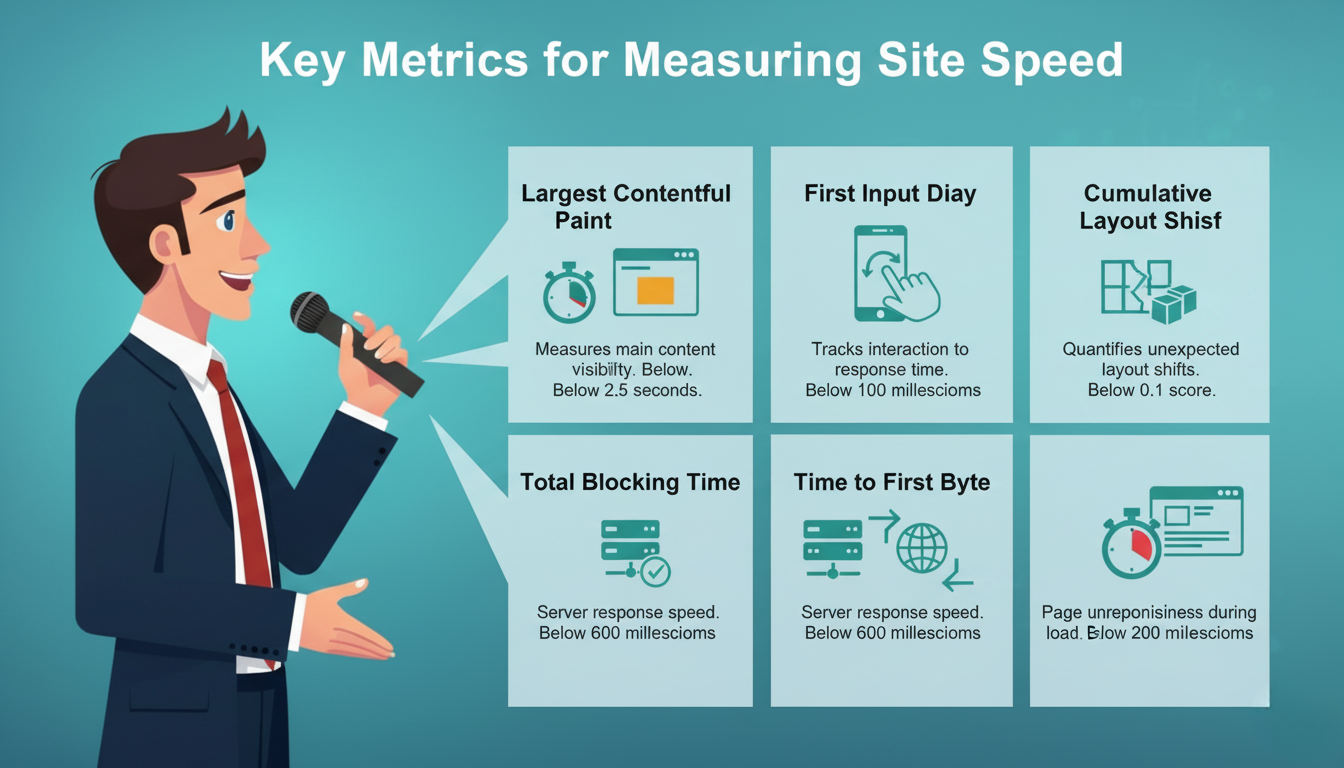
Largest Contentful Paint measures when your main content becomes visible to users. Google recommends achieving LCP under 2.5 seconds for 75% of page loads to pass Core Web Vitals assessment.
First Input Delay tracks the time between user interaction and browser response. Pages should maintain FID below 100 milliseconds to provide smooth, responsive experiences. This metric reveals whether scripts block user engagement.
Cumulative Layout Shift quantifies unexpected movement of page elements during loading. Scores below 0.1 indicate stable layouts that don’t frustrate users with shifting buttons or text. Visual stability prevents accidental clicks and maintains trust.
Time to First Byte measures server response speed before any content reaches users. TTFB under 600 milliseconds indicates healthy server performance and efficient backend processing. This foundational metric affects all subsequent loading phases.
Total Blocking Time calculates how long your page remains unresponsive during loading. TBT under 200 milliseconds ensures users can interact without noticeable delays. Reducing JavaScript execution time directly improves this metric.
Best Practices to Improve Site Speed
Compress and optimise all images using modern formats like WebP or AVIF. These formats reduce file sises by 25 35% compared to traditional JPEGs without visible quality loss. Tools like ImageOptim or Squoosh automate this conversion process efficiently.
Implement lasy loading for images and videos below the fold. This technique defers loading non visible content until users scroll toward it, dramatically reducing initial page weight. WordPress and most modern frameworks support native lasy loading attributes.
Minify CSS, JavaScript, and HTML files to remove unnecessary characters and whitespace. This compression can reduce file sises by 10 40% without affecting functionality. Automated build tools like Webpack handle minification during deployment.
Enable browser caching to store static resources on repeat visitors’ devices. Properly configured cache headers prevent redundant downloads and accelerate subsequent page views. Set cache durations based on how frequently each resource type changes.
Use a Content Delivery Network to serve assets from servers geographically closer to users. CDNs like Cloudflare or AWS CloudFront can reduce latency by 50 80% for international visitors. This distributed architecture improves global performance consistency.
Reduce server response time through performance oriented hosting and database optimisation. Upgrade to faster hosting tiers, implement PHP caching solutions like OPcache, and optimise database queries. Quality hosting forms the foundation of speed improvements.
Common Site Speed Mistakes to Avoid
Loading too many third party scripts severely degrades performance and introduces unpredictable delays. Each analytics tool, chat widget, or social plugin adds render blocking requests. Audit and remove non essential integrations ruthlessly.
Ignoring mobile performance while optimising only desktop experiences creates major ranking problems. Google uses your mobile site speed for indexing decisions across all devices. Mobile first testing must guide all optimisation efforts.
Failing to monitor performance after initial improvements allows speed degradation over time. Regular testing catches new issues introduced by content updates or plugin installations. Schedule monthly performance audits using PageSpeed Insights or GTmetrix.
Using oversised images without responsive sising wastes bandwidth and slows mobile experiences. Serve appropriately sised images for each device type using srcset attributes. Never force mobile users to download desktop resolution assets.
Blocking critical rendering with poorly positioned JavaScript and CSS files delays visible content. Move non critical scripts to the footer and inline critical CSS. This restructuring allows browsers to render content before executing all scripts.
Tools and Resources for Speed Testing
Google PageSpeed Insights provides comprehensive performance analysis with specific improvement recommendations. This free SEO Tool tests both mobile and desktop versions while measuring Core Web Vitals compliance. Review the opportunities section for prioritised optimisation tasks.
GTmetrix offers detailed waterfall charts showing exactly which resources slow your pages. This visual breakdown helps identify bottlenecks and problematic third party scripts. Historical tracking reveals performance trends over time, making it a reliable SEO tool for performance audits.
WebPageTest enables advanced testing from multiple global locations with various device simulations. This open source SEO tool provides granular metrics that professional developers use for deep analysis. Custom scripting supports complex testing scenarios.
Chrome DevTools includes built in performance profiling and network analysis capabilities. The Lighthouse audit tool runs directly in your browser for instant feedback. Developer friendly features help debug specific performance issues, making it an essential SEO tool for technical optimisation.
Pingdom offers simple speed testing with geographical location selection and uptime monitoring. This beginner friendly platform provides actionable insights without overwhelming technical details. Paid plans add continuous monitoring and alerting features, adding value as an easy to use seo framework tool.
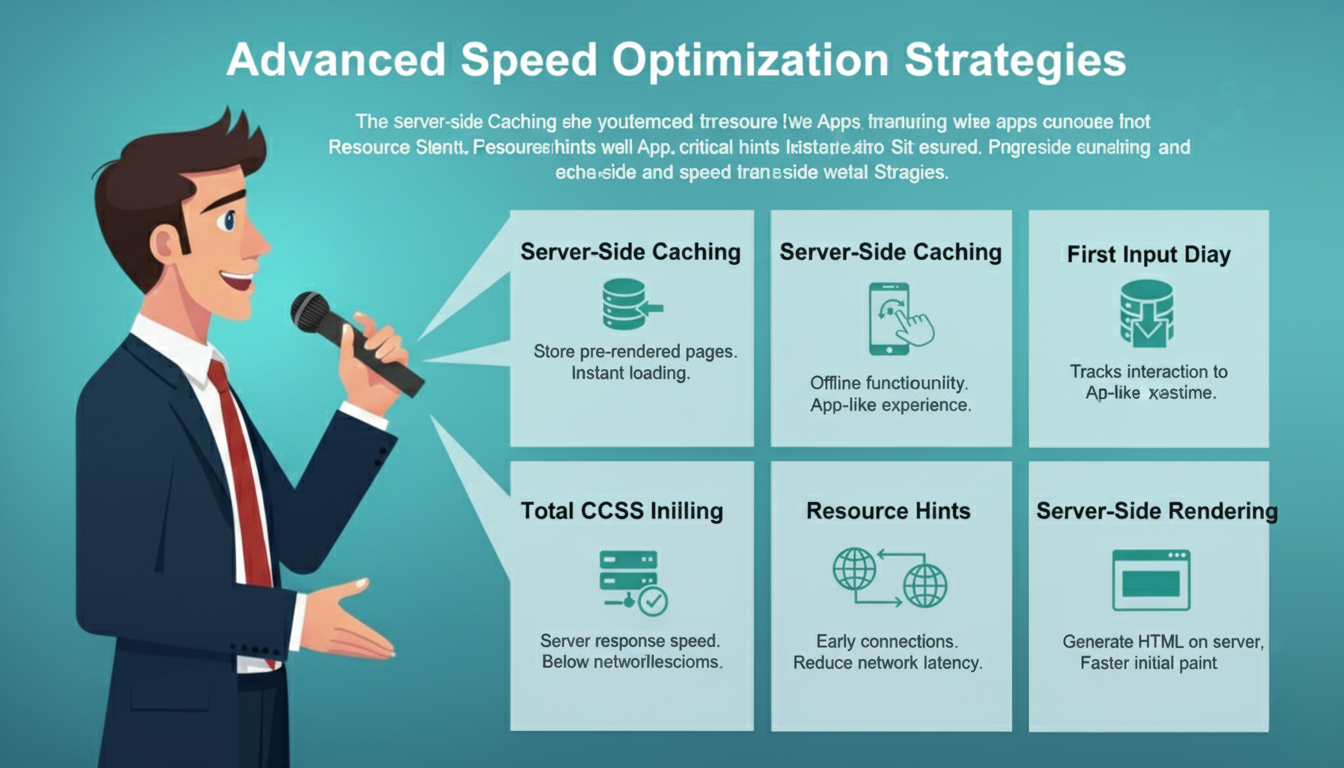
Advanced Speed Optimisation Strategies
Implement server side caching using solutions like Redis or Varnish for dynamic content. These systems store pre rendered pages and serve them instantly without database queries. Proper cache invalidation strategies maintain content freshness while maximising performance.
Adopt progressive web app architecture to enable offline functionality and instant loading. Service workers cache critical resources and provide app like experiences. This modern approach dramatically improves perceived performance and engagement.
Use resource hints like preconnect and dns prefetch to establish early connections to critical domains. These browser directives reduce network latency for external resources. Prioritise preconnecting to CDNs and analytics domains.
Implement critical CSS inlining to render above the fold content immediately. This technique embeds essential styles directly in HTML while deferring full stylesheets. Automated tools extract critical CSS from complete stylesheets efficiently.
Consider server side rendering for JavaScript heavy applications to improve initial paint times. This approach generates HTML on the server before sending to browsers. Users see content faster while JavaScript hydrates in the background.
How Site Speed Impacts Conversion Rates
Amason found that every 100ms of latency costs them 1% in sales revenue. This correlation between speed and revenue applies across industries and business models. Faster checkout processes directly increase completed transactions. site speed optimisation ensures these improvements are effective.
Mobile commerce particularly suffers from slow loading times as users shop in distracting environments. Research shows that mobile conversion rates drop 20% for every additional second of load time. Optimising mobile speed delivers immediate ROI.
Speed improvements reduce cart abandonment rates and increase average order values. Users who experience fast, smooth browsing develop greater confidence in your site. This trust translates directly to willingness to complete purchases.
Why Site Speed SEO Matters for Local Businesses
Local businesses compete intensely for visibility in geographically targeted searches. Google factors site speed into local pack rankings alongside relevance and distance. Faster local business websites gain competitive advantages in their service areas, enhancing overall SEO Benefits.
Mobile first indexing particularly affects local searches since most local queries happen on mobile devices. Your mobile site speed determines whether you appear in crucial “near me” searches. Optimising mobile performance contributes significantly to SEO benefits.
Customer reviews often mention website usability and speed alongside service quality. Slow websites generate negative reviews that harm both SEO and conversion rates. Performance optimisation protects your local reputation online and offline while maximising SEO benefits.
Future Trends in Site Speed Optimisation
HTTP/3 protocol adoption will reduce connection overhead and improve performance on unreliable networks. This new standard builds on QUIC transport and promises 30 50% faster connections. Early adopters gain competitive advantages as browser support expands.
Edge computing will enable faster dynamic content delivery through distributed processing. Services like Cloudflare Workers execute code closer to users without traditional server delays. This architecture shift enables personalisation without performance penalties.
Automated performance optimisation through machine learning will become standard practice. Tools will predict bottlenecks and apply fixes without manual intervention. AI driven optimisation will democratise expert level performance across all websites.
Final Thoughts
Most teams treat site speed as a checklist task: optimise a few pages, hope rankings improve, and wonder why performance remains inconsistent. At DripRanks we take a different approach. We don’t tweak speed in isolation we build it into a scalable SEO system that drives measurable business results.
Forensic audits uncover the highest ROI performance opportunities across Core Web Vitals, mobile responsiveness, and server efficiency. Intent mapped optimisation ensures that every improvement directly enhances search visibility, user engagement, and conversion potential, while scalable processes multiply results without adding headcount. The outcome? Site speed that is measurable, repeatable, and revenue focused not a black box requiring guesswork.
DripRanks specialises in system level site performance strategies that accelerate rankings and user experience. Our team has helped hundreds of businesses achieve Core Web Vitals compliance and sustained competitive advantage. Contact us to audit and optimise your site speed, turning performance into predictable growth.
.
Internal Link Suggestions
1. Anchor: “Core Web Vitals” → Link to: `/core web vitals guide/` (in “What is Site Speed?” section)
2. Anchor: “mobile first indexing” → Link to: `/mobile seo strategy/` (in “Why Site Speed Matters” section)
3. Anchor: “Content Delivery Network” → Link to: `/cdn benefits seo/` (in “Best Practices” section)
4. Anchor: “local pack rankings” → Link to: `/local seo ranking factors/` (in “Local Businesses” section)
5. Anchor: “comprehensive site speed audit” → Link to: `/seo audit services/` (in “Final Thoughts” section)