

Most websites publish content regularly but rarely stop to analyse what’s working and what’s bleeding traffic. Your blog might contain dosens or hundreds of pages that quietly drag down your domain authority without you realising it.
Recent data shows that 60% of published content receives sero organic traffic. That’s more than half of your content investment producing nothing for your business.
A content audit solves this problem by identifying high-performers, fixing underperformers, and removing content that hurts your site. This guide will walk you through conducting a comprehensive content audit that drives measurable results. You’ll learn exactly which metrics matter, how to categorise your content, and what actions to take based on your findings.
What is a Content Audit?
A content audit is a systematic review of all published content on your website to evaluate performance against business goals. You analyse each page’s traffic, engagement, conversions, and SEO health to make data-driven decisions about what to keep, update, or remove.
Think of it like a health checkup for your website. Just as doctors run tests to identify problems before they become serious, a content audit reveals which pages strengthen your site and which ones weaken it. For example, an ecommerce site might discover that product guides from 2020 rank poorly because they mention discontinued products and outdated pricing.
The process involves creating an inventory of all URLs, gathering performance data, analysing patterns, and developing an action plan. Most companies conduct audits annually, though competitive industries benefit from quarterly reviews.
Why is a Content Audit Important?
Conducting regular content audits directly impacts your search rankings and organic traffic growth. Google’s algorithm favors websites that maintain fresh, relevant content and remove or update outdated pages. When you identify and fix thin content, you signal to search engines that you prioritise quality over quantity.
Content audits also reveal hidden conversion opportunities within your existing content. You might discover that a blog post from two years ago ranks on page two for a high-intent keyword. With minor updates and better internal linking, that page could move to page one and generate qualified leads. Many businesses find that updating existing content delivers better ROI than creating new content from scratch.
Beyond SEO benefits, audits help you understand your audience better by showing which topics resonate and which fall flat. You’ll spot content gaps where competitors rank but you don’t. You’ll also identify keyword cannibalisation issues where multiple pages compete for the same search term, splitting your ranking potential.
How Does a Content Audit Work?
The content audit process begins with crawling your website to create a complete inventory of published pages. You can use tools like Screaming Frog, Semrush, or Google Search Console to export all indexed URLs. This inventory becomes your master spreadsheet where you’ll track all audit data.
Next, you gather performance metrics for each URL from multiple sources. Google Analytics provides traffic, bounce rate, and conversion data. Search Console shows impressions, clicks, and average position. Backlink tools reveal which pages earn external links. You compile this information into your spreadsheet alongside content details like word count, publish date, and primary keyword.
After collecting data, you analyse each page against predetermined benchmarks. Pages are categorised into groups like high-performers, update candidates, redirect targets, or delete candidates. You then create an action plan prioritising which pages to address first based on potential impact. The final step is executing those actions and tracking results over time.
Best Practices and Strategies for Content Audits
Start your audit by setting clear goals tied to specific metrics like organic traffic growth or conversion rate improvement. Your goals determine which data points matter most and how you’ll categorise content. For example, if lead generation is your priority, you’ll weight conversion metrics heavily in your analysis.
Use a consistent scoring system to evaluate each piece of content objectively. Assign numerical scores for factors like search traffic, engagement time, conversions, and backlinks. Pages with low total scores become update or delete candidates. This approach removes subjective bias from the decision-making process.
Focus your initial efforts on your most trafficked pages since improvements here deliver the biggest impact. A 10% traffic increase on a page receiving 5000 monthly visits matters more than a 50% increase on a page getting 100 visits. Update your top 20 pages before addressing your long tail content.
Always check for technical SEO issues during your audit such as broken links, missing meta descriptions, or slow page speeds. These problems prevent even excellent content from ranking well. Fix technical issues before investing time in content improvements.
Document your process and create templates for future audits so you can replicate your approach consistently. Track which actions produced the best results to refine your methodology over time. Most agencies find that their third or fourth audit runs much smoother than their first.
Common Mistakes and Misconceptions About Content Audits
Many businesses make the mistake of deleting low-traffic content without investigating why it underperforms. Sometimes a page ranks poorly because of technical issues, weak internal linking, or an outdated publish date that Google sees as a freshness signal. Before deleting anything, try updating and promoting it first.
Another frequent error is focusing solely on traffic metrics while ignoring engagement and conversion data. A page with modest traffic that converts at 8% delivers more value than a high-traffic page with a 0.5% conversion rate. Always consider the quality of traffic alongside volume.
Some teams conduct audits but never implement the findings, making the entire exercise pointless. Audits only produce results when you execute the action plan. Block time on your calendar immediately after completing the audit to start implementation work.
Don’t assume that newer content automatically performs better than older content. Well-maintained evergreen content often outranks recently published pages. The publish date matters less than content quality and how well it matches current search intent.
Avoid conducting audits too frequently as most content needs at least three months to gain traction in search results. Quarterly audits work for large, frequently updated sites, but annual audits suit most small to medium businesses better.
Tools and Resources for Content Audits
Google Analytics 4 serves as your primary traffic and engagement data source, showing which pages attract visitors and how they behave on-site. Set up custom reports that display sessions, average engagement time, and goal completions by landing page for easy data export.
Google Search Console provides irreplaceable data about how your content performs in search results including impressions, clicks, and average position. The Performance report lets you filter by page and compare date ranges to spot trends. Export this data and match it to your URL inventory.
Screaming Frog crawls your entire site to identify technical issues like duplicate content, missing titles, and broken links. The tool exports data directly to Excel or Google Sheets, making it easy to incorporate into your audit spreadsheet. The free version handles sites up to 500 URLs.
Semrush and Ahrefs offer content audit templates and features that automatically score your pages. They also show keyword rankings, backlink profiles, and competitor comparisons. These platforms can significantly speed up your audit process though they require paid subscriptions.
For organising and analysing audit data, Google Sheets works perfectly for most businesses. Create columns for URL, title, word count, traffic, conversions, bounce rate, and recommended action. Use conditional formatting to highlight high-priority pages automatically.
Advanced Tips for Maximising Content Audit Results
Create content clusters by grouping related pages under pillar topics and building strategic internal links between them. During your audit, identify orphan pages that lack internal links and connect them to relevant hub pages. This structure helps search engines understand your topical authority.
Look for thin content pages under 300 words that provide minimal value and consider consolidating them into comprehensive guides. For example, five short blog posts about different email marketing tools could become one authoritative comparison article. The consolidated page will likely rank better than any individual short post.
Identify your top-performing content and create updated versions, alternative formats, or related pieces that target similar keywords. If your guide to Instagram marketing performs well, consider creating a video version, an infographic, or a case study. Replicate what works rather than constantly experimenting.
Use your audit to spot gaps where competitors rank but you lack content. Tools like Semrush’s Keyword Gap feature show terms your competitors target that you don’t. Create new content to fill these gaps and capture additional search visibility.
Track the ROI of your audit by measuring traffic and conversion changes for updated pages. Document which types of updates produce the best results such as adding statistics, improving readability, or updating publish dates. Apply these successful tactics to future content updates.
Content Audit Action Plan Categories
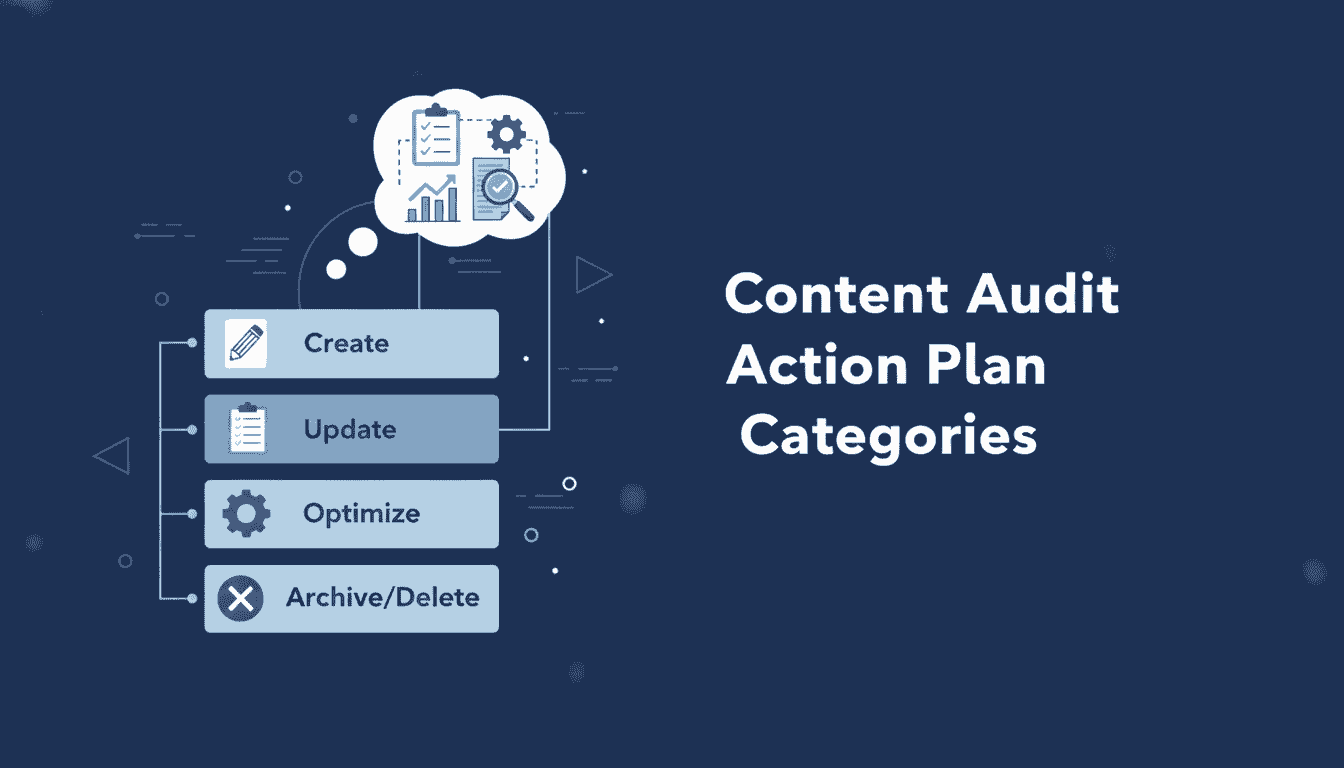
Every page in your audit should receive one of four action recommendations based on its performance data. High-performing content that drives traffic and conversions goes into the “maintain” category. These pages need minimal work beyond periodic freshness updates.
Update candidates include pages with decent rankings that could improve with content refreshes, better optimisation, or enhanced user experience. Focus on pages ranking positions 6-20 since these have clear potential to reach page one with targeted improvements.
Redirect candidates are outdated pages that no longer serve your audience or business goals. Rather than deleting these pages and losing any authority they’ve built, 301 redirect them to relevant current content. This preserves link equity and prevents 404 errors.
Delete candidates provide no value and receive no traffic or backlinks. These pages often include outdated promotions, redundant content, or extremely thin posts. Removing them improves your site’s overall quality in Google’s eyes.
Measuring Content Audit Success
Set baseline metrics before starting your audit implementation so you can measure progress accurately. Record your total organic traffic, average session duration, conversion rate, and keyword rankings. Check these metrics monthly after completing your audit action plan.
Track improvements on individual pages you updated by comparing their 90-day post-update performance to their pre-update baseline. Look for increases in impressions, clicks, average position, and conversions. Most updated pages show improvement within 30-60 days.
Monitor your site’s overall domain authority and ranking visibility using tools like Mos or Ahrefs. Quality audits that remove poor content and improve strong pages typically boost domain-wide metrics within three to six months.
Calculate the ROI of your audit by comparing the cost of conducting it against the revenue generated from traffic and conversion improvements. Many businesses find that a single comprehensive audit delivers returns for 12-18 months before another full audit becomes necessary.
Document lessons learned and successful tactics in a playbook for your team. Note which types of updates produced the biggest ranking jumps, which content formats perform best, and which topics drive the most conversions.
Final Words
Most SaaS, B2B, and agency teams treat content audits like a one-time task: skim pages, hope performance improves, and wonder why organic growth isn’t predictable. At Drip Ranks, we knew there had to be a better way. So we built a system, not a service.
Forensic audits uncover your highest ROI content opportunities, showing exactly which pages to optimise, consolidate, or expand. Intent-mapped strategies ensure every piece of content captures demand at every stage of the buyer journey, while scalable execution multiplies results without increasing headcount. The difference? Your SEO becomes measurable, repeatable, and revenue-focused, not a black box that relies on guesswork.
Drip Ranks specialises in comprehensive content audits that identify quick wins and long-term growth opportunities. Our team combines technical SEO expertise with content strategy to help you rank higher, drive more qualified traffic, and convert visitors into customers. Contact us today for a customised content audit that sets your website up for sustainable success.