
More than 70% of mobile app users abandon applications within 90 days of installation, according to recent industry data. This staggering statistic reveals a critical challenge facing businesses today: capturing attention is no longer enough.
User engagement represents the depth and quality of interactions between your audience and your brand across digital touchpoints. It measures how actively people participate with your content, products, and services over time, including content length.
Strong user engagement directly correlates with higher customer lifetime value, improved brand loyalty, and sustainable revenue growth. When users consistently interact with your platform, they’re more likely to convert, recommend your business, and remain customers long term.
This comprehensive guide explores actionable user engagement strategies, essential metrics to track, common pitfalls to avoid, and proven tactics that drive measurable results. You’ll learn how to transform passive visitors into active participants who contribute to your business success.
What is User Engagement
User engagement describes the emotional and behavioral connection between users and a digital product, service, or brand. It encompasses all meaningful interactions, from page views and clicks to comments, shares, and purchases. Understanding what is SEO helps connect this concept to how search engines evaluate user signals engagement metrics often indicate the quality and relevance of your content.
True engagement goes beyond surface level metrics like traffic volume. It reflects genuine interest, satisfaction, and willingness to invest time and attention in your offerings. A highly engaged user might spend 10 minutes exploring your content, while a disengaged visitor bounces within seconds.
Engagement occurs across multiple dimensions simultaneously. Cognitive engagement involves mental attention and processing, emotional engagement creates feelings and connections, and behavioral engagement manifests through observable actions like scrolling, clicking, or commenting.
Why User Engagement Matters for Business Growth
User engagement serves as a leading indicator of business health and future performance. Engaged users generate 23% more revenue on average compared to disengaged counterparts, according to marketing research data.
High engagement rates signal product market fit and customer satisfaction. When people voluntarily return to your platform and spend increasing amounts of time, they’re voting with their attention. This organic validation proves your value proposition resonates.
Engagement metrics also predict retention and churn more accurately than acquisition costs. A user who engages daily for two weeks has exponentially higher lifetime value than someone who visits once. This makes engagement optimisation one of the highest ROI activities for sustainable growth.
Search engines reward engagement through ranking algorithms. Google analyses dwell time, bounce rate, and return visits to assess content quality. Better engagement signals translate directly into improved organic visibility and reduced customer acquisition costs.
How User Engagement Works Across Digital Channels
User engagement operates through interconnected feedback loops between content delivery and user response. Your platform presents stimuli like content, features, or notifications, and users respond with varying levels of interaction based on perceived value. Understanding these patterns also connects to key SEO benefits, as higher engagement signals help improve visibility and ranking potential in search engines.
Each interaction generates data that informs subsequent experiences. When a user watches a video completely, algorithms learn to recommend similar content. This personalisation increases relevance, which drives deeper engagement in a reinforcing cycle.
Timing plays a crucial role in engagement mechanics. Push notifications sent at optimal times based on user behavior patterns achieve 3-5x higher open rates than generic broadcasts. Context aware triggers based on user actions create natural engagement opportunities.
Multi channel engagement creates compound effects. A user who follows you on social media, subscribes to emails, and uses your mobile app demonstrates stronger commitment than single channel participants. Cross channel strategies amplify overall engagement levels.
Essential User Engagement Metrics to Track
Session duration measures average time users spend during each visit. This metric reveals content stickiness and value perception. Increasing session duration from two to five minutes often correlates with significant conversion rate improvements.
Pages per session indicates content discoverability and navigation effectiveness. Higher numbers suggest users find relevant material easily and want to explore further. This metric helps identify navigation issues or content gaps.
Return visitor rate tracks what percentage of users come back within specific timeframes. A healthy digital product typically sees 30-40% of users return within 30 days. Low return rates signal onboarding problems or insufficient ongoing value.
Interaction rate measures active participation versus passive consumption. Comments, shares, likes, and downloads demonstrate higher engagement than simple page views. Social platforms consider interaction rate their most critical success metric.
Custom event tracking monitors specific high value actions unique to your business model. An e learning platform might track course completion rates, while e-commerce sites focus on cart additions and wishlist saves.
Proven Strategies to Increase User Engagement
Personalisation transforms generic experiences into relevant journeys tailored to individual preferences. Netflix attributes 80% of watched content to its recommendation algorithm. Implementing even basic personalisation typically increases engagement by 20-30%, especially when combined with proper title tags.
Interactive content invites participation rather than passive consumption. Quizzes, polls, calculators, and assessments generate 2x more engagement than static articles. Interactive elements transform readers into active participants.
Community building creates social connections that transcend transactional relationships. User forums, comment sections, and peer interaction features give people reasons to return beyond core functionality. Reddit’s engagement success stems primarily from community dynamics.
Gamification applies game design elements to non game contexts. Progress bars, achievement badges, leaderboards, and challenges tap into intrinsic motivation. Duolingo’s streak feature drives daily engagement through simple game mechanics.
Value first content strategy prioritises genuine utility over promotional messaging. Educational tutorials, industry insights, and problem solving resources establish authority while delivering immediate value. This approach builds trust that enables long term engagement.
Progressive disclosure reveals functionality gradually as users demonstrate readiness. Overwhelming new users with all features simultaneously creates confusion and abandonment. Staged feature introduction based on usage patterns improves activation and retention.
Common User Engagement Mistakes to Avoid
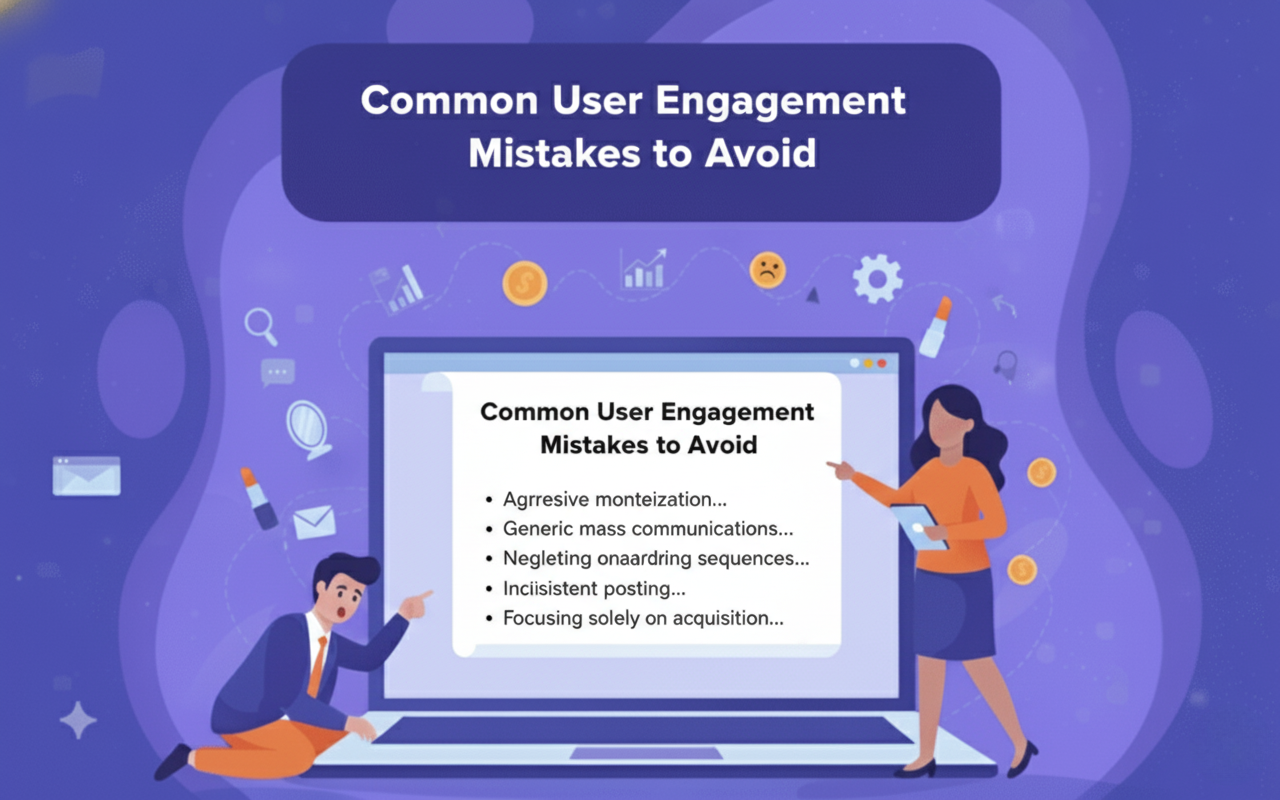
Aggressive monetisation before establishing value destroys early stage engagement. Bombarding new users with subscription prompts, ads, or upgrade requests creates friction before they experience core benefits. Wait until users demonstrate consistent engagement before introducing commercial elements.
Ignoring mobile experience optimisation alienates the majority of digital audiences. Over 60% of web traffic originates from mobile devices, yet many websites deliver poor mobile experiences. Slow loading times and difficult navigation on smartphones kill engagement instantly, negatively impacting content readability.
Generic mass communications fail to resonate with diverse audience segments. Sending identical emails to all subscribers ignores individual interests and behaviors. Segmented, personalised messaging achieves 3-6x higher engagement than one sise fits all approaches.
Neglecting onboarding sequences leaves new users confused about next steps. Clear guidance during initial sessions dramatically improves activation rates. Apps with structured onboarding see 50% higher retention than those without.
Inconsistent posting schedules damage audience expectations and habits. Regular content cadence trains users when to return. Sporadic publishing prevents habit formation and reduces overall engagement over time.
Focusing solely on acquisition while ignoring retention wastes resources. Acquiring new users costs 5-25x more than retaining existing ones. Engagement optimisation primarily benefits retention, delivering superior ROI compared to constant acquisition spending.
Tools and Resources for Engagement Optimisation
SEO tools like Google Analytics provide comprehensive behavioral data including session duration, bounce rate, and user flow visualisation. The free platform tracks standard engagement metrics and supports custom event configuration for business specific actions.
Hotjar reveals qualitative engagement insights through heatmaps, session recordings, and user surveys. Watching actual user sessions uncovers friction points and confusion that quantitative data alone cannot explain.
Mixpanel specialises in product analytics with powerful cohort analysis and funnel tracking. The platform excels at identifying engagement patterns across user segments and measuring feature adoption.
Intercom enables personalised messaging based on user behavior triggers. Automated email sequences, in app messages, and chatbot interactions can be configured to respond to specific engagement signals.
Optimisely facilitates A/B testing of engagement hypotheses. Systematic experimentation removes guesswork from optimisation efforts, allowing data driven decisions about feature changes and content variations.
Amplitude offers advanced analytics with retention analysis and behavioral cohorts. The platform helps identify which user actions correlate with long term engagement and business outcomes.
Advanced User Engagement Tactics for 2025
Behavioral email automation triggers messages based on specific user actions or inaction. Cart abandonment sequences, re engagement campaigns for dormant users, and milestone celebrations maintain connection without manual effort.
Micro commitments leverage psychological consistency principles. Small initial actions like profile completion or preference selection increase likelihood of larger future engagements. Each small commitment builds investment in the relationship.
Social proof integration displays real time user activity to create urgency and validation. Showing “127 people viewing this item” or “Sarah from Chicago just purchased” taps into fundamental human tendencies toward conformity.
Push notification personalisation based on individual usage patterns maximises relevance while minimising annoyance. Machine learning algorithms determine optimal timing and content for each user rather than broadcasting generic messages.
Predictive analytics identify users at risk of disengagement before they leave. Churn prediction models allow proactive intervention with targeted retention offers or content recommendations.
Voice and conversational interfaces reduce friction in user interactions. Voice search optimisation and chatbot assistants make engagement more natural and accessible across contexts.
Video content integration addresses changing consumption preferences. Short form video generates significantly higher engagement than text across most platforms and demographics. TikTok’s explosive growth demonstrates video’s engagement power.
Final Words
Most SaaS, B2B, and agency teams treat user engagement like an afterthought: add content, hope visitors stick, and wonder why retention and conversions aren’t predictable. At Drip Ranks, we knew there had to be a better way. So we built a system, not a service.
Forensic audits uncover your highest ROI engagement opportunities, identifying where personalised experiences, interactive content, and UX improvements drive measurable results. Intent-mapped strategies ensure every touchpoint captures demand at each stage of the buyer journey, while scalable execution multiplies outcomes without increasing headcount. The difference? Your engagement becomes measurable, repeatable, and revenue-focused, not a black box that relies on guesswork.
Drip Ranks specialises in comprehensive digital strategies that boost retention, conversions, and lasting customer relationships. Contact us today for a custom engagement audit and discover how our data-driven approach can turn your audience into a highly engaged, revenue-generating asset.
Internal Link Opportunities
1. Anchor: “content strategy” → Link to: `/content marketing strategy` (within H2: Proven Strategies to Increase User Engagement)
2. Anchor: “customer lifetime value” → Link to: `/customer retention strategies` (within Introduction)
3. Anchor: “conversion rate improvements” → Link to: `/conversion rate optimisation` (within H2: Essential User Engagement Metrics)
4. Anchor: “technical SEO” → Link to: `/technical seo guide` (within Final Words)
5. Anchor: “behavioral data” → Link to: `/analytics tracking setup` (within H2: Tools and Resources)