


Most website owners struggle to stand out in search results even with great content. You might rank on page one but still lose clicks to competitors who appear more attractive.
Schema markup solves this problem by transforming plain search listings into rich results that grab attention. Recent data shows websites using structured data see up to 30% higher click through rates compared to standard blue links.
Dripranks helps businesses implement advanced schema strategies that turn invisible technical advantages into visible search dominance. This guide reveals exactly how schema markup works and how to deploy it correctly for maximum ranking benefits.
You will learn what schema markup is, why Google rewards it, which types drive results, and how to implement it without coding knowledge. You will also discover common implementation errors that waste your effort and advanced strategies few competitors use.
What is Schema Markup?
Schema markup is structured data code you add to your website’s HTML to help search engines understand your content better. It provides explicit context about what your page contains rather than forcing Google to guess from text alone.
Think of schema as a translator between your website and search engines. When you mark up a recipe page, schema tells Google which part is the ingredient list, cooking time, and user rating. This clarity helps Google display your content as rich results with star ratings and images.
Schema uses vocabulary from Schema.org, a collaborative project by Google, Microsoft, Yahoo, and Yandex. There are over 800 schema types covering everything from local businesses to medical conditions. Each type includes specific properties that describe different aspects of your content.
Why is Schema Markup Important for SEO?
Schema markup directly improves how your content appears in search results, which increases organic traffic and explains part of What is SEO in action. Google confirmed that structured data helps them understand page content and enables rich result features that attract more clicks.
Pages with schema markup earn average CTR improvements between 20–40% according to various industry studies. Higher click through rates signal content quality to Google, which can indirectly boost your rankings over time.
Schema also prepares your website for voice search and AI driven search experiences. When users ask Alexa or Google Assistant questions, these systems pull answers from pages with clear structured data. Your content becomes the source for direct answers.
Rich results created by schema take up more visual space on search pages. This pushes competitors down and gives your listing more prominence. Users naturally click larger, more informative results before scrolling to standard listings.
How Does Schema Markup Work?
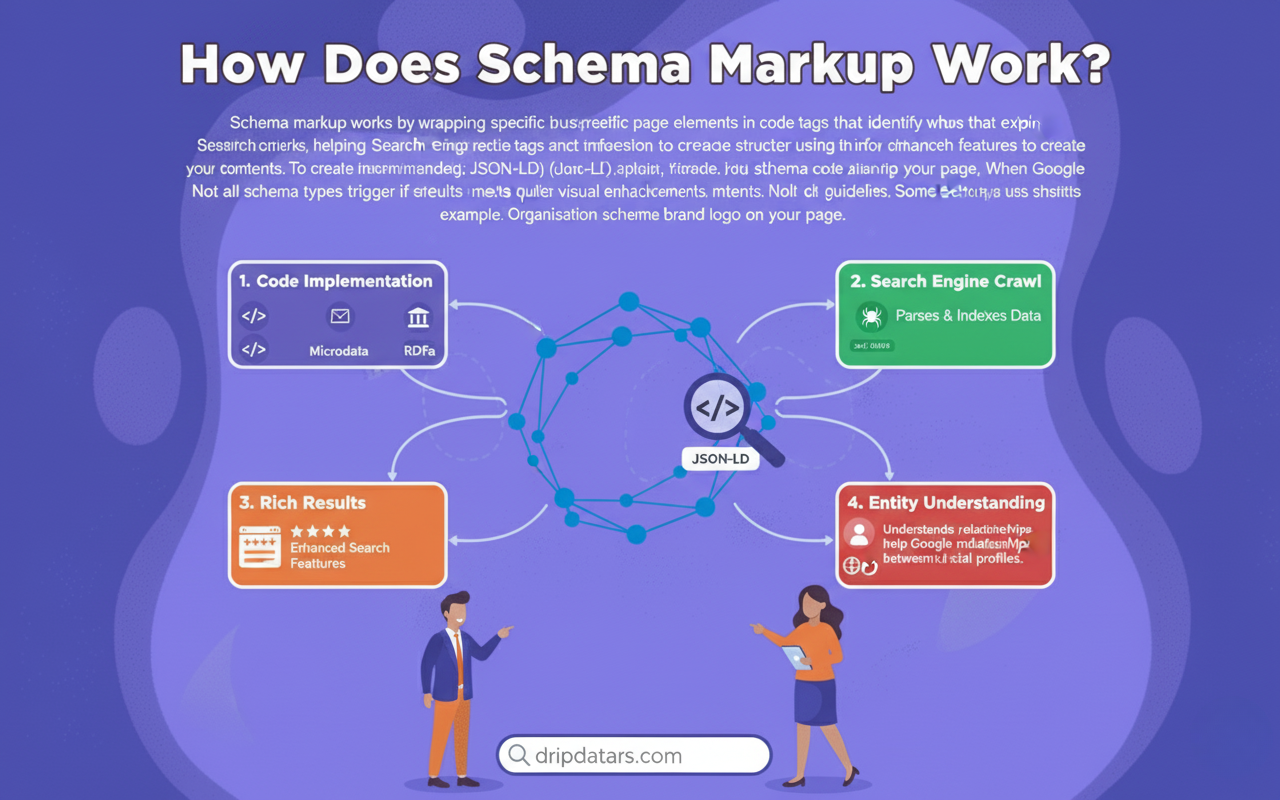
Schema markup works by wrapping specific page elements in code tags that identify what each piece of content represents, helping demonstrate How SEO Works in improving search visibility. Search engine crawlers read these tags and extract structured information to create enhanced search features.
You implement schema using three main formats: JSON LD (recommended by Google), Microdata, or RDFa. JSON LD separates the schema code into a script block, making it easier to add without disrupting your visible content.
When Google crawls your page, it parses the schema code and stores the structured data in its index. This data becomes eligible for rich results if it meets quality guidelines and matches user search intent.
Not all schema types trigger visual enhancements. Some schema exists purely to help Google understand relationships between entities on your page. For example, Organisation schema connects your brand name to your logo and social profiles.
Types of Schema Markup That Drive Results
Article schema works for blog posts and news content. It enables headline features in Google News and can display publish dates, author names, and featured images directly in search results.
Local Business schema appears essential for any company serving customers at physical locations. This schema type powers Google Maps results, displays business hours, phone numbers, and generates the knowledge panel for your brand.
Product schema transforms ecommerce listings by showing prices, availability, and review stars in search results. Shoppers can see product details before clicking, which increases qualified traffic and conversion rates. Proper image optimisation enhances these listings by improving load times and visual appeal.
FAQ schema creates expandable question and answer sections directly in search results. This schema type captures featured snippet positions and lets you dominate more screen real estate for competitive keywords.
Review schema displays star ratings beneath your search listing, creating instant credibility. This works for individual product reviews or aggregate ratings for your entire business or specific service pages.
Recipe schema benefits food bloggers by showing cooking time, calorie counts, and ratings in image rich search results. Google also features recipe content in specialised carousel results for food related searches.
Best Practices and Implementation Strategies
Start with schema types that match your primary content and business model. Local businesses should implement Organisation and Local Business schema first. Ecommerce sites prioritise Product and Review schema before other types.
Use Google’s Structured Data Markup Helper to generate schema code without manual coding. Simply select your content type, highlight page elements, and the tool creates properly formatted JSON LD code you can paste into your HTML.
Validate all schema implementations with Google’s Rich Results Test tool before publishing. This free tool identifies errors, warns about missing required properties, and confirms whether your markup qualifies for rich results.
Place JSON LD schema code in the head section of your HTML or immediately after the opening body tag. Consistent placement makes future updates easier and ensures crawlers find your structured data quickly.
Keep schema markup updated when you change page content. Outdated schema showing incorrect prices or discontinued products violates Google guidelines and can trigger manual penalties or loss of rich result eligibility.
Combine multiple schema types on the same page when appropriate. A blog post can include Article schema plus FAQ schema for questions answered within the content. Product pages work well with Product, Review, and Breadcrumb schema together.
Common Schema Markup Mistakes and Corrections
Marking up content that doesn’t exist on your page violates Google’s guidelines. Some websites add fake reviews or misleading information in schema hoping to manipulate rankings. Google detects this and removes all rich results as punishment.
Using incorrect schema types for your content causes implementation failures. Applying Recipe schema to a product page confuses search engines and prevents any rich results from appearing for your listing.
Missing required properties makes your schema incomplete and ineligible for enhanced features. Each schema type has mandatory fields that must be filled. Check Schema.org documentation for your chosen type’s requirements.
Implementing schema only on your homepage wastes potential. Every content page deserves appropriate structured data. Category pages, service pages, and blog posts all benefit from relevant schema markup.
Forgetting to test schema after website updates leads to broken implementations. Theme changes, plugin updates, or content management system migrations can corrupt your structured data without obvious visual errors on your site.
Using outdated schema formats reduces effectiveness. Microdata still works but JSON LD is Google’s preferred format because it separates structured data from HTML, making implementation cleaner and maintenance easier.
Tools and Resources for Schema Implementation
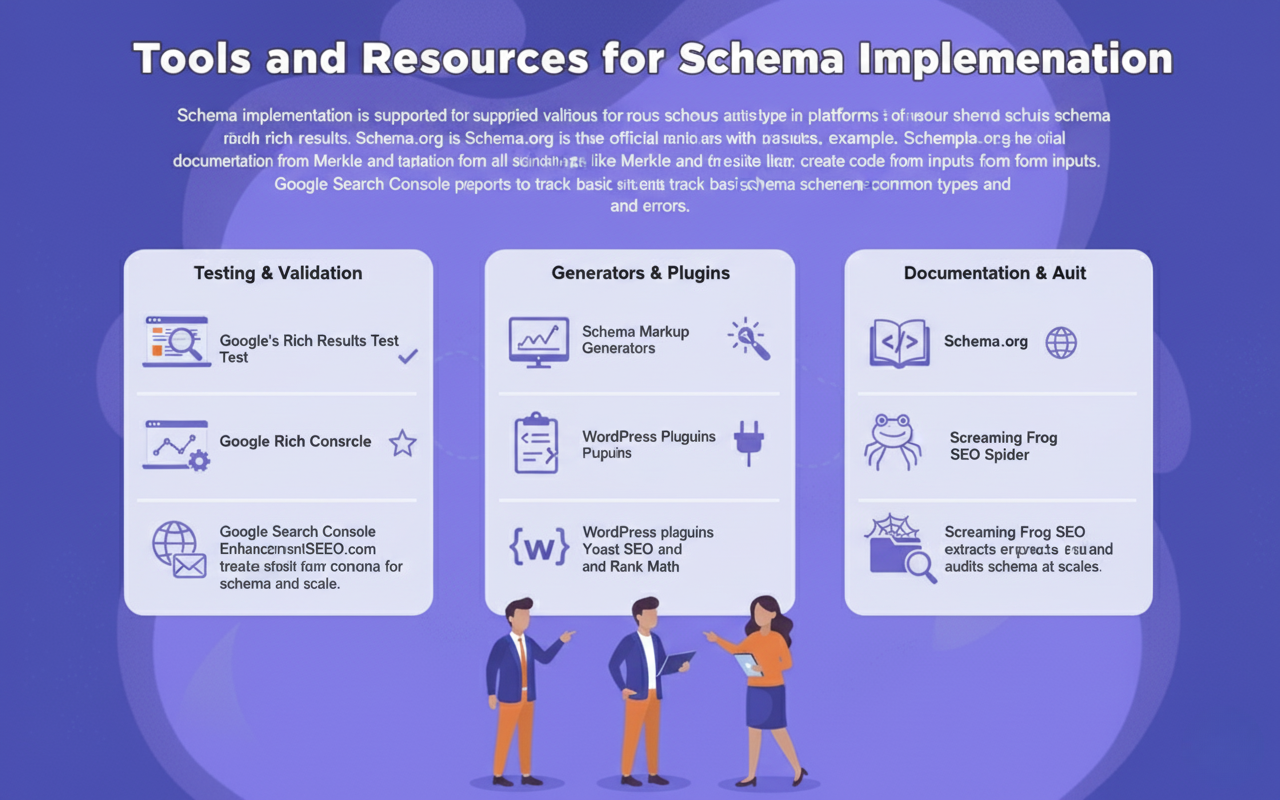
Google’s Rich Results Test shows exactly how Google reads your schema and which rich results you qualify for. This SEO Tool provides specific error messages and improvement suggestions for every schema type, helping ensure correct keyword placement in your structured data.
Schema.org serves as the official documentation source for all schema types and properties. The website includes examples for every schema vocabulary, showing proper syntax and required versus optional fields.
Schema markup generators like Merkle’s tool or Technical SEO.com’s generator create code for common schema types through simple forms. These SEO Tools work perfectly for beginners who need quick implementation without learning code
Yoast SEO and Rank Math plugins automatically add basic schema to WordPress sites. These SEO Tools handle Article, Organisation, and Person schema but require manual configuration for advanced types like FAQ or HowTo.
Google Search Console’s Enhancement reports track your schema performance. These SEO Tools show which pages have valid structured data, which have errors, and how many impressions your rich results receive.
Screaming Frog SEO Spider extracts existing schema from any website during crawls. This SEO Tool helps you audit competitor schema implementations and verify your own structured data across hundreds or thousands of pages.
Advanced Schema Strategies for Competitive Advantages
Nest related schema types to create comprehensive structured data profiles. A local business page can include Organisation schema containing PostalAddress and GeoCoordinates nested within it, plus AggregateRating schema connected to the business entity.
Implement schema for entity relationships to strengthen topical authority. Author schema on blog posts that links to a Person schema with sameAs properties connecting to professional social profiles builds entity recognition.
Target video schema for content with embedded or hosted videos. VideoObject schema can trigger video thumbnail results in standard search and help your content appear in Google’s video search with duration and upload date.
Use Event schema for webinars, conferences, or local happenings. Event markup creates calendar style results with dates and ticket information, capturing users who specifically search for upcoming events in your industry.
Apply HowTo schema to tutorial content and guides. This schema type generates step by step visual results in search pages, often appearing as featured snippets with images for each instruction step.
Experiment with Speakable schema for content optimised for voice assistants. This newer schema type identifies sections of your content suitable for text to speech conversion, positioning you for voice search results.
Future of Schema Markup and Structured Data
Artificial intelligence search engines rely heavily on structured data to train models and deliver accurate answers. As AI tools like ChatGPT and Bard integrate with search, schema markup becomes the primary way machines understand and cite your content, supporting a clear meta description strategy.
Google continues expanding schema types and rich result eligibility. Recent additions include EducationalOccupationalCredential schema and VirtualLocation properties for hybrid events, showing Google’s commitment to evolving structured data capabilities.
Visual search features increasingly depend on schema markup. Product schema with high quality images and detailed attributes performs better in Google Lens and visual shopping experiences that represent search’s future direction.
Structured data will likely become a stronger ranking factor as search engines can better reward accurately marked up content. Websites providing clear, verified information through schema may receive preferential treatment in competitive search landscapes.
Schema markup gives your website a technical advantage that most competitors ignore. Implementing structured data correctly transforms how search engines understand and display your content, directly increasing clicks and indirectly supporting better rankings.
Most teams treat schema as a checkbox task: add basic markup, hope Google uses it, and move on. At DripRanks, we take a different approach. We don’t deploy schema in isolation we engineer it into a scalable SEO system.
Forensic content audits identify high impact schema opportunities tied directly to visibility and click through rates. Advanced implementations strengthen entity understanding, enhance rich results eligibility, and support intent mapped content across the buyer journey. The result? Schema becomes measurable, repeatable, and performance driven not a passive technical add on.
DripRanks specialises in system level schema optimisation that turns structured data into a competitive advantage. Contact us to transform schema from simple markup into a growth lever for organic traffic and search visibility.